[bunun]
![so_[bunun]_2016_book_1.jpg](https://images.squarespace-cdn.com/content/v1/67aea55951ff3a188fdb76f8/1752044434661-6IHY7ON61A3G3RTNGJ6N/so_%5Bbunun%5D_2016_book_1.jpg)
![ex_[bunun]_2016_book cover.jpg](https://images.squarespace-cdn.com/content/v1/67aea55951ff3a188fdb76f8/1751615862611-NV3SEOB0LVUJVXY4BNNF/ex_%5Bbunun%5D_2016_book+cover.jpg)
![ex_[bunun]_2016_invation card_1.jpg](https://images.squarespace-cdn.com/content/v1/67aea55951ff3a188fdb76f8/1751615996562-DTGOCQPJN27M4TNTCT58/ex_%5Bbunun%5D_2016_invation+card_1.jpg)
![ex_[bunun]_2016_book_10.jpg](https://images.squarespace-cdn.com/content/v1/67aea55951ff3a188fdb76f8/1751616048900-M61TCSKXOWTCKVD2M6NP/ex_%5Bbunun%5D_2016_book_10.jpg)
![ex_[bunun]_2016_book_2.jpg](https://images.squarespace-cdn.com/content/v1/67aea55951ff3a188fdb76f8/1751615869001-0AP46IPE88XAV24G5G9Y/ex_%5Bbunun%5D_2016_book_2.jpg)
![ex_[bunun]_2016_book_4.jpg](https://images.squarespace-cdn.com/content/v1/67aea55951ff3a188fdb76f8/1751615883976-H4L6J26N4LH4HO0ILSPA/ex_%5Bbunun%5D_2016_book_4.jpg)
![ex_[bunun]_2016_book_5.jpg](https://images.squarespace-cdn.com/content/v1/67aea55951ff3a188fdb76f8/1751615891509-U9EC2JNGM0IA0ADO2X81/ex_%5Bbunun%5D_2016_book_5.jpg)
![ex_[bunun]_2016_book_6.jpg](https://images.squarespace-cdn.com/content/v1/67aea55951ff3a188fdb76f8/1751615910228-80IIE4FBXZZADIMY4P8E/ex_%5Bbunun%5D_2016_book_6.jpg)
![ex_[bunun]_2016_book_7.jpg](https://images.squarespace-cdn.com/content/v1/67aea55951ff3a188fdb76f8/1751615905313-15JLSW8LZSXUVZ0VC0NY/ex_%5Bbunun%5D_2016_book_7.jpg)
![ex_[bunun]_2016_book_8.jpg](https://images.squarespace-cdn.com/content/v1/67aea55951ff3a188fdb76f8/1751615926044-0633J6V1N5FZ372MY9R4/ex_%5Bbunun%5D_2016_book_8.jpg)
![ex_[bunun]_2016_book_9.jpg](https://images.squarespace-cdn.com/content/v1/67aea55951ff3a188fdb76f8/1751615938753-TKL0WQJ0NCKH83U0OAL8/ex_%5Bbunun%5D_2016_book_9.jpg)
![ex_[bunun]_2016_book_3.jpg](https://images.squarespace-cdn.com/content/v1/67aea55951ff3a188fdb76f8/1751615878717-GZ9NUIBD61LNG3BNU1B9/ex_%5Bbunun%5D_2016_book_3.jpg)
[weave]
As clothing no longer requires the elders’ careful spinning and twisting of threads, and as tools for carrying are no longer limited to bamboo baskets or straps, can these time-honored weaving techniques still wrap around us and bring warmth?
The idea emerges naturally—to weave together traditional craft and the existing living landscape, such as natural rockfalls, creating a space of renewed beauty.
編織
當衣服不再需要老人家們一絲絲的製線、揉捻,背東西的器具不再只有竹簍或竹背帶,我們是否可以讓這傳承已久的編織法依然可以包覆我們帶來溫暖。「既有生活場域(天然崩石)結合編織成為更美麗的空間想法油然而生。」
![so_[bunun]_2016_weave_10.jpg](https://images.squarespace-cdn.com/content/v1/67aea55951ff3a188fdb76f8/1752044662652-MTNKYQ9EGDCXF2K96KC9/so_%5Bbunun%5D_2016_weave_10.jpg)
![ex_[bunun]_2016_sketch_5.jpg](https://images.squarespace-cdn.com/content/v1/67aea55951ff3a188fdb76f8/1751616306337-9J07YG7UIL2ZEF904RBR/ex_%5Bbunun%5D_2016_sketch_5.jpg)
![ex_[bunun]_2016_prototype_weave_1.jpg](https://images.squarespace-cdn.com/content/v1/67aea55951ff3a188fdb76f8/1751615894710-BKHLBHIWBE94CDG9M8LC/ex_%5Bbunun%5D_2016_prototype_weave_1.jpg)
![ex_[bunun]_2016_prototype_weave_2.jpg](https://images.squarespace-cdn.com/content/v1/67aea55951ff3a188fdb76f8/1751615894928-G4ADSC8BFWZ4FYGCNAHA/ex_%5Bbunun%5D_2016_prototype_weave_2.jpg)
![ex_[bunun]_2016_prototype_weave_3.jpg](https://images.squarespace-cdn.com/content/v1/67aea55951ff3a188fdb76f8/1751615903375-KB8UTE32VIAFBA4E14UQ/ex_%5Bbunun%5D_2016_prototype_weave_3.jpg)
![ex_[bunun]_2016_prototype_weave_4.jpg](https://images.squarespace-cdn.com/content/v1/67aea55951ff3a188fdb76f8/1751615903417-7GGOI552X85TM843WGC3/ex_%5Bbunun%5D_2016_prototype_weave_4.jpg)
![ex_[bunun]_2016_prototype_weave_5.JPG](https://images.squarespace-cdn.com/content/v1/67aea55951ff3a188fdb76f8/1751615923613-R2DE5S6MP2TC5KAKKWGB/ex_%5Bbunun%5D_2016_prototype_weave_5.JPG)
![ex_[bunun]_2016_prototype_weave_7.JPG](https://images.squarespace-cdn.com/content/v1/67aea55951ff3a188fdb76f8/1751615942950-MI0IIY81LW59PLF3P3C1/ex_%5Bbunun%5D_2016_prototype_weave_7.JPG)
![ex_[bunun]_2016_prototype_weave_6.JPG](https://images.squarespace-cdn.com/content/v1/67aea55951ff3a188fdb76f8/1751615925065-TFBSQNZS9KYMEYOZZZ15/ex_%5Bbunun%5D_2016_prototype_weave_6.JPG)
![ex_[bunun]_2016_8.jpg](https://images.squarespace-cdn.com/content/v1/67aea55951ff3a188fdb76f8/1751615993259-50DI1H0D3DCJ4QS0X9FL/ex_%5Bbunun%5D_2016_8.jpg)
![ex_[bunun]_2016_weave_17jpg.jpg](https://images.squarespace-cdn.com/content/v1/67aea55951ff3a188fdb76f8/1751857424187-GJ73MDKSPVMLUGGTRDME/ex_%5Bbunun%5D_2016_weave_17jpg.jpg)
![ex_[bunun]_2016_weave_7.jpg](https://images.squarespace-cdn.com/content/v1/67aea55951ff3a188fdb76f8/1751855979653-BO015U75589MUHTUOMRX/ex_%5Bbunun%5D_2016_weave_7.jpg)
![ex_[bunun]_2016_weave_6.jpg](https://images.squarespace-cdn.com/content/v1/67aea55951ff3a188fdb76f8/1751855979269-3M5KBY0MKFJ72ORK5VJH/ex_%5Bbunun%5D_2016_weave_6.jpg)
[trap]
Traps—once essential survival tools—were among the core skills every young boy in the tribe needed to master to become a man. They ensured food on the table and stood as proof that a man had walked this earth. The animal bones found in and around the house marked the path he once took.
Now that money can easily buy what was once hard-earned meat, how can we reinterpret these ancestral techniques to serve a purpose in our time?
Thus, the “Elevated Trap-Inspired Shelter” was born—a new structural form rooted in the traditional吊腳陷阱 (suspended-leg trap) design.
陷阱
陷阱,以前賴以為生的技術,是每個部落男孩要成為男人必備的技能之一,他讓我們得以溫飽,也是一個男人曾來過這個世界的證明,那些在家屋裡外的獸骨,都是曾走過之路的痕跡。當金錢能夠買到以前很難取得的肉,這樣的技法,我們是否可以轉譯成這個時代的功用?「吊腳陷阱結構的新型態工寮」因而誕生。
![so_[bunun]_2016_trap_10.jpg](https://images.squarespace-cdn.com/content/v1/67aea55951ff3a188fdb76f8/1752044686592-ITT98EHTIF105LSPNEUU/so_%5Bbunun%5D_2016_trap_10.jpg)
![ex_[bunun]_2016_sketch_4.jpg](https://images.squarespace-cdn.com/content/v1/67aea55951ff3a188fdb76f8/1751616380969-2RVGI4JC6K4HXU7PRDSQ/ex_%5Bbunun%5D_2016_sketch_4.jpg)
![ex_[bunun]_2016_trap_9.jpg](https://images.squarespace-cdn.com/content/v1/67aea55951ff3a188fdb76f8/1751855786909-EDOBO6POAUROFXHG1UX3/ex_%5Bbunun%5D_2016_trap_9.jpg)
![ex_[bunun]_2016_prototype_trap_1.jpg](https://images.squarespace-cdn.com/content/v1/67aea55951ff3a188fdb76f8/1751616060365-G0497RYD6YXLH9U39Z7F/ex_%5Bbunun%5D_2016_prototype_trap_1.jpg)
![ex_[bunun]_2016_prototype_trap_2.jpg](https://images.squarespace-cdn.com/content/v1/67aea55951ff3a188fdb76f8/1751616063252-9IB2T5JDSMVDX20CKQNF/ex_%5Bbunun%5D_2016_prototype_trap_2.jpg)
![ex_[bunun]_2016_prototype_trap_3.jpg](https://images.squarespace-cdn.com/content/v1/67aea55951ff3a188fdb76f8/1751616064959-6LF8LHBQSMR7ZO538B25/ex_%5Bbunun%5D_2016_prototype_trap_3.jpg)
![ex_[bunun]_2016_prototype_trap_4.jpg](https://images.squarespace-cdn.com/content/v1/67aea55951ff3a188fdb76f8/1751616066255-TWFWD3EBLVRZHLY8AY7N/ex_%5Bbunun%5D_2016_prototype_trap_4.jpg)
![ex_[bunun]_2016_prototype_trap_5.JPG](https://images.squarespace-cdn.com/content/v1/67aea55951ff3a188fdb76f8/1751616072600-MX22YMA0314NBTHXJMRH/ex_%5Bbunun%5D_2016_prototype_trap_5.JPG)
![ex_[bunun]_2016_prototype_trap_6.JPG](https://images.squarespace-cdn.com/content/v1/67aea55951ff3a188fdb76f8/1751616073559-57QFN5DO2NXZH4F0C2JQ/ex_%5Bbunun%5D_2016_prototype_trap_6.JPG)
![ex_[bunun]_2016_prototype_trap_7.JPG](https://images.squarespace-cdn.com/content/v1/67aea55951ff3a188fdb76f8/1751616079544-7LLS6NPHM9KLLR3ZZ2JJ/ex_%5Bbunun%5D_2016_prototype_trap_7.JPG)
![ex_[bunun]_2016_trap_7.jpg](https://images.squarespace-cdn.com/content/v1/67aea55951ff3a188fdb76f8/1751855781162-A0KTITEXZOWSAL4JOQSI/ex_%5Bbunun%5D_2016_trap_7.jpg)
![ex_[bunun]_2016_trap_8.jpg](https://images.squarespace-cdn.com/content/v1/67aea55951ff3a188fdb76f8/1751855785730-SY3C1I9QG0E3JBNH7W3S/ex_%5Bbunun%5D_2016_trap_8.jpg)
![ex_[bunun]_2016_3.jpg](https://images.squarespace-cdn.com/content/v1/67aea55951ff3a188fdb76f8/1751616025443-HVZ7S9COGE7AFLKNICVG/ex_%5Bbunun%5D_2016_3.jpg)
![ex_[bunun]_2016_5.jpg](https://images.squarespace-cdn.com/content/v1/67aea55951ff3a188fdb76f8/1751616047067-V1H5QYQVGW90IZGMQERR/ex_%5Bbunun%5D_2016_5.jpg)
![ex_[bunun]_2016_11.jpg](https://images.squarespace-cdn.com/content/v1/67aea55951ff3a188fdb76f8/1751616062025-HEGEF278ZE7M8PQEX4S8/ex_%5Bbunun%5D_2016_11.jpg)
![ex_[bunun]_2016_1.jpg](https://images.squarespace-cdn.com/content/v1/67aea55951ff3a188fdb76f8/1751616009558-66O5PEDKRU7XCN97E4Y9/ex_%5Bbunun%5D_2016_1.jpg)
[stone]
As concrete structures rise and land becomes bound by deeds and contracts, the quiet understanding once marked by stacked stones has begun to fade. Traditional slate houses are now reduced to objects of cultural display—visited, but no longer lived in.
How, then, can we embody the core wisdom of these stone dwellings—structures that once held the weight of generations, built solely through stacking?
A new vision emerges: a stage shaped by the art of piling and binding, reimagining the strength of the past in the language of today.
砌石
當水泥建築林立,土地需要地契制約,那些堆疊石頭區隔界線的美好默契漸漸消失,傳統石板屋成為參訪的道具,我們該如何體現石板屋那曾經僅靠堆疊就能乘載我們的重量超過好幾世紀的智慧精髓。「堆砌與繫綁的舞台成為了新的想像」
![so_[bunun]_2016_stone_7.jpg](https://images.squarespace-cdn.com/content/v1/67aea55951ff3a188fdb76f8/1752044777022-FSLNB9WX7693SEQJ6EA8/so_%5Bbunun%5D_2016_stone_7.jpg)
![ex_[bunun]_2016_sketch_1.jpg](https://images.squarespace-cdn.com/content/v1/67aea55951ff3a188fdb76f8/1751616401126-DSPME6SJCFEA2XW5G3JF/ex_%5Bbunun%5D_2016_sketch_1.jpg)
![ex_[bunun]_2016_prototype_stone_12.jpg](https://images.squarespace-cdn.com/content/v1/67aea55951ff3a188fdb76f8/1751616079119-DLGZ8YZPFLBV575QS014/ex_%5Bbunun%5D_2016_prototype_stone_12.jpg)
![ex_[bunun]_2016_prototype_stone_11.jpg](https://images.squarespace-cdn.com/content/v1/67aea55951ff3a188fdb76f8/1751616079371-W7MLUUJ7AY222IEHIL4Q/ex_%5Bbunun%5D_2016_prototype_stone_11.jpg)
![ex_[bunun]_2016_prototype_stone_13.jpg](https://images.squarespace-cdn.com/content/v1/67aea55951ff3a188fdb76f8/1751616081884-4C5HE7BGYK7M2NA70KQ5/ex_%5Bbunun%5D_2016_prototype_stone_13.jpg)
![ex_[bunun]_2016_prototype_stone_14.jpg](https://images.squarespace-cdn.com/content/v1/67aea55951ff3a188fdb76f8/1751616082494-PN2YC0ZVXTRYF0X9GXNE/ex_%5Bbunun%5D_2016_prototype_stone_14.jpg)
![ex_[bunun]_2016_prototype_stone_16.JPG](https://images.squarespace-cdn.com/content/v1/67aea55951ff3a188fdb76f8/1751616089646-RB3HWW60R36NJXWG3PEN/ex_%5Bbunun%5D_2016_prototype_stone_16.JPG)
![ex_[bunun]_2016_prototype_stone_17.JPG](https://images.squarespace-cdn.com/content/v1/67aea55951ff3a188fdb76f8/1751616093427-MBZSRRJ61W5KDBBB7KHD/ex_%5Bbunun%5D_2016_prototype_stone_17.JPG)
![ex_[bunun]_2016_prototype_stone_15.JPG](https://images.squarespace-cdn.com/content/v1/67aea55951ff3a188fdb76f8/1751616089213-5A9QVUMAVCBJBNWG1NY5/ex_%5Bbunun%5D_2016_prototype_stone_15.JPG)
![ex_[bunun]_2016_stone_1.jpg](https://images.squarespace-cdn.com/content/v1/67aea55951ff3a188fdb76f8/1751616749291-1QT6X1DFIWQBJ5U5X94I/ex_%5Bbunun%5D_2016_stone_1.jpg)
![ex_[bunun]_2016_13.jpg](https://images.squarespace-cdn.com/content/v1/67aea55951ff3a188fdb76f8/1751616548084-VH5V8MENZIXBUZASWBGI/ex_%5Bbunun%5D_2016_13.jpg)
![ex_[bunun]_2016_stone_4.jpg](https://images.squarespace-cdn.com/content/v1/67aea55951ff3a188fdb76f8/1751855692226-K3S8KUK50JR0SGTDEJL7/ex_%5Bbunun%5D_2016_stone_4.jpg)
![ex_[bunun]_2016_stone_5.jpg](https://images.squarespace-cdn.com/content/v1/67aea55951ff3a188fdb76f8/1751855691273-FM18OIOIR4H0XYDU61XW/ex_%5Bbunun%5D_2016_stone_5.jpg)
![ex_[bunun]_2016_stone_8.jpg](https://images.squarespace-cdn.com/content/v1/67aea55951ff3a188fdb76f8/1751855698936-WSNZJ52MRJVL58SPF750/ex_%5Bbunun%5D_2016_stone_8.jpg)
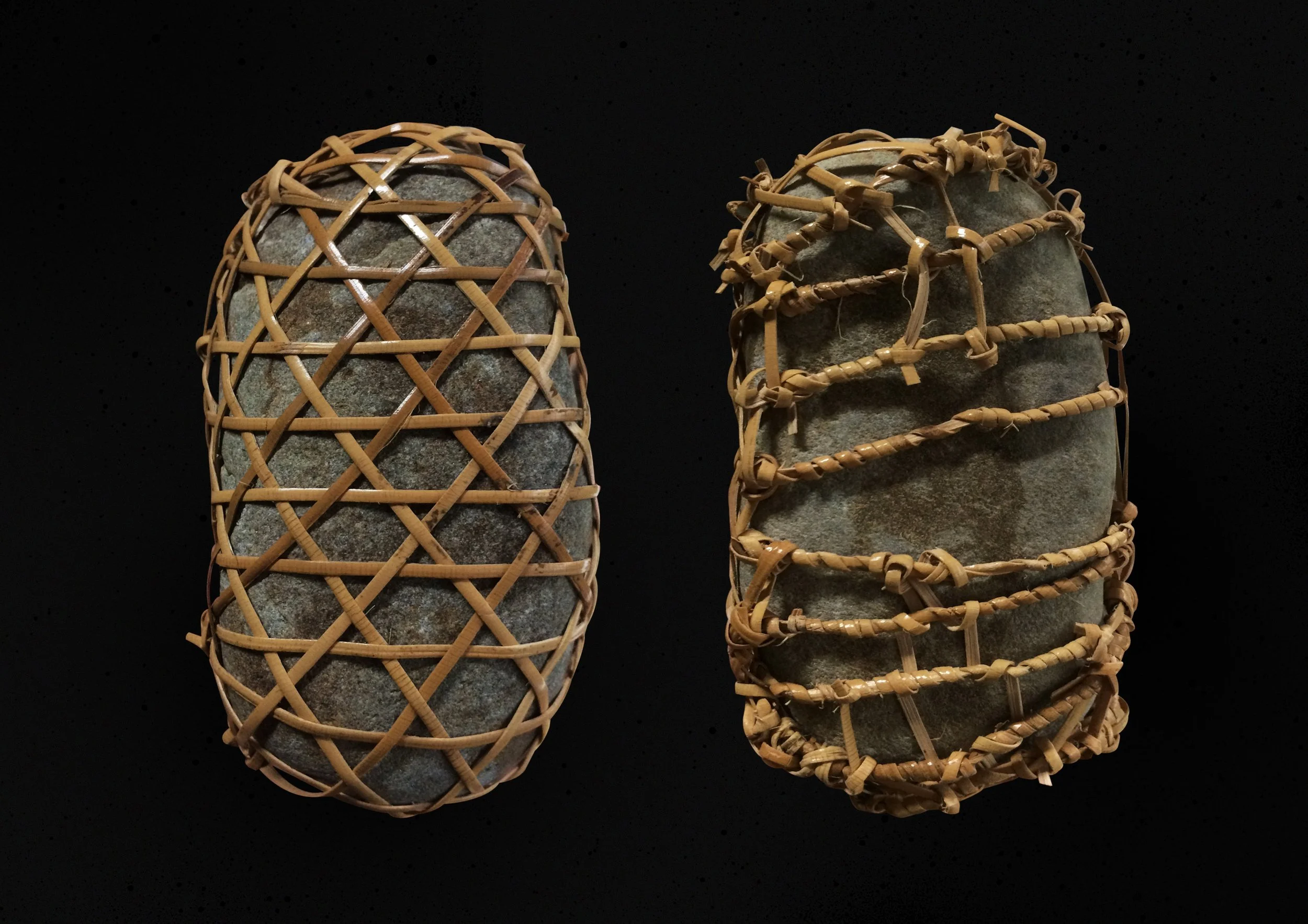
workshop: weaved stone paperweight
The cross weave and hexagonal weave are ancient techniques of unknown origin, passed down through millennia as part of traditional indigenous knowledge. These weaving methods are commonly found in everyday objects of the Bunun people.
This workshop combines the rational structure of hand-weaving with the organic irregularity of natural stones, creating a compelling contrast. The finished pieces can serve as paperweights or bases for moss planters—miniature landscapes for the tabletop.
工作坊:編織石塊紙鎮
十字編與六角編是超越數千年已不可考的傳統智慧,這些編織手法常見於布農族的生活器物之中,本課程以理性的人手編織結合於自然隨機的石塊中,創造有趣的對比效果,完成之作品能做為紙鎮或苔蘚盆栽的胎體使用,成為桌上一隅微縮風景。
![ex_[bunun]_2016_workshop_13.jpg](https://images.squarespace-cdn.com/content/v1/67aea55951ff3a188fdb76f8/1751857280491-I22IKAP223Z5GUTCIF3N/ex_%5Bbunun%5D_2016_workshop_13.jpg)
![ex_[bunun]_2016_workshop_15.jpg](https://images.squarespace-cdn.com/content/v1/67aea55951ff3a188fdb76f8/1751857283156-ZUKVGZBEL00IG72GP6XU/ex_%5Bbunun%5D_2016_workshop_15.jpg)
![ex_[bunun]_2016_workshop_8.jpg](https://images.squarespace-cdn.com/content/v1/67aea55951ff3a188fdb76f8/1751857275133-FI6A2V0K6I6M6ZEIIIP3/ex_%5Bbunun%5D_2016_workshop_8.jpg)
![ex_[bunun]_2016_workshop_11.jpg](https://images.squarespace-cdn.com/content/v1/67aea55951ff3a188fdb76f8/1751857278256-FTTY237E2BZQC72B0XME/ex_%5Bbunun%5D_2016_workshop_11.jpg)
![ex_[bunun]_2016_workshop_4.jpg](https://images.squarespace-cdn.com/content/v1/67aea55951ff3a188fdb76f8/1751857270178-9WZ2OGQCRA7HEZPAS64A/ex_%5Bbunun%5D_2016_workshop_4.jpg)
![ex_[bunun]_2016_workshop_3.jpg](https://images.squarespace-cdn.com/content/v1/67aea55951ff3a188fdb76f8/1751857268255-PA606P6GCNG64UM3MWNL/ex_%5Bbunun%5D_2016_workshop_3.jpg)
![ex_[bunun]_2016_workshop_7.jpg](https://images.squarespace-cdn.com/content/v1/67aea55951ff3a188fdb76f8/1751857273246-MAPMK9JPMQ9TURYISPUP/ex_%5Bbunun%5D_2016_workshop_7.jpg)
![ex_[bunun]_2016_workshop_9.jpg](https://images.squarespace-cdn.com/content/v1/67aea55951ff3a188fdb76f8/1751857275543-MQSBAGPZKR4PA89FR38M/ex_%5Bbunun%5D_2016_workshop_9.jpg)
![ex_[bunun]_2016_workshop_1.jpg](https://images.squarespace-cdn.com/content/v1/67aea55951ff3a188fdb76f8/1751857266472-HQ7C2ZVDFUXEN0BMKWYM/ex_%5Bbunun%5D_2016_workshop_1.jpg)
![ex_[bunun]_2016_workshop_10.jpg](https://images.squarespace-cdn.com/content/v1/67aea55951ff3a188fdb76f8/1751857277442-81HX8TZW49H60M88AKWM/ex_%5Bbunun%5D_2016_workshop_10.jpg)
![ex_[bunun]_2016_workshop_12.jpg](https://images.squarespace-cdn.com/content/v1/67aea55951ff3a188fdb76f8/1751857279804-WQH7VMF7VFZ4FNHNH7TR/ex_%5Bbunun%5D_2016_workshop_12.jpg)
workshop: miniature trap potted plant
The Bunun people's traditional hanging snare trap, used to catch medium to large animals such as muntjacs and wild boars, reflects a deep, place-based hunting wisdom—crafted entirely from natural materials found in the environment. This workshop introduces participants to this traditional skill and reimagines it as a miniature tabletop landscape, transforming the hunter’s craft into a Bunun-inspired planter for modern living spaces.
工作坊:微縮陷阱植栽
布農族捕捉山羌、山豬等中大型動物的傳統吊腳陷阱,是一項完全就地取材的傳統獵人智慧,本課程帶領學員學習此技能,並將其應用於小型桌上盆栽,化作桌上一隅布農獵人的生活風景。
![so_[bunun]_2016_workshop_5.jpg](https://images.squarespace-cdn.com/content/v1/67aea55951ff3a188fdb76f8/1752044889052-ZGYVPYFO9YGBN3107BBK/so_%5Bbunun%5D_2016_workshop_5.jpg)
![ex_[bunun]_2016_workshop_5.jpg](https://images.squarespace-cdn.com/content/v1/67aea55951ff3a188fdb76f8/1751858370583-RUOZ1PYOEV2Y7N5XXHC0/ex_%5Bbunun%5D_2016_workshop_5.jpg)
![ex_[bunun]_2016_workshop_16.jpg](https://images.squarespace-cdn.com/content/v1/67aea55951ff3a188fdb76f8/1751858373246-2OQTOKGZZPPYGD0DZR2Y/ex_%5Bbunun%5D_2016_workshop_16.jpg)
2016
[bunun]
Walk a Different Path.
We began to rethink our relationship with this land—wondering whether more diverse possibilities exist. Without violating the teachings and instructions passed down through generations by our elders, how might we present the essence of their wisdom today?
By reinterpreting and repurposing the tribe’s existing natural landscapes and traditional knowledge—be it skills, craftsmanship, or daily living spaces—we open new imaginative directions for the future development of the community.
Without overdevelopment or land trading, we aim to recognize our strengths and create place-specific, unique living experiences rooted in quality rather than quantity. Instead of drawing massive crowds, we reinterpret the timeless wisdom of our people as something of high value in the modern world—inviting the right people to enter the village in the right way.
2016|[bunun]|08/04-05, 06-07|Mahawan|Wanrong|Hualien
organizer|Wanrong Youth Association, O-Bei-Lai
adviser|Tourism Promotion Project for Indigenous Areas – 2016 East Rift Valley Tribal Tourism Promotion Plan (Phase II), Ministry of Culture Youth Village Cultural Project (Ma Yuan Tribe Island Puzzle Project Phase II)
sponsor|YAMAHA, Volkswagen, CPC Corporation Taiwan, Legislator Kao Chin Su-mei's Office, East Rift Valley National Scenic Area Administration, FAP+DA
curator|Cheng Tsung FENG, Sheng Da TSAI, Yung En MA
2016
農地農用
走一條,不一樣的路。
我們開始重新思索,這塊土地與我們的關係,是不是還有更多元的可能,在不違反老人家世世代代的訓誡與教導之下,那些智慧本質該如何被呈現。
利用部落內現有的自然地景與傳統智慧(技藝、工藝、生活場域)重新轉譯與利用,讓部落對於未來可能發展走向能有新的想像。
不需過度開發、不用買賣土地,瞭解自身優勢,打造「屬地性」的特殊生活體驗,從質出發,不用大量人潮進入,重新詮釋部落智慧對於現今世界的高度價值,吸引對的人用對的方式走進聚落之中。
2016|農地農用 [bunun]|08/04-05, 06-07|馬遠部落 |萬榮|花蓮
主辦單位|萬榮青年會、歐北來
輔導單位|原住民族地區觀光推動計畫-105年度花東縱谷部落旅遊推廣計畫(第二期)、文化部青年村落文化計畫(馬遠部落島嶼拼圖計畫第二期
贊助單位|YAMAHA、福斯汽車、臺灣中油股份有限公司、高金素梅委員辦公室、花東縱谷國家風景區管理處、旋之恆管理顧問有限公司
策展人|范承宗、蔡昇達、馬詠恩