Hualien Animals Color


Art Director | Cheng Tsung FENG
“In Hualien Animal Color project, design plays the role of serving the function of the ten bio-materials, and we intentionally remove the strong shape and intention of the design, and the design must not override the material itself, so that the viewer can focus on the bio-materials and the possibilities and experimentation of the color generation.”
Cheng Tsung FENG, who loves ancient wisdom and traditional craftsmanship, seems to be more confident when talking about his role in the Hualien Color 3 project. “We have accumulated to the third year, and we are familiar with natural materials to a certain extent.”
This year, we have chosen to use ten kinds of creatures commonly found in Hualien as a guide to explore the colors brought to us by the creatures from the wisdom of craftsmanship accumulated in human history. After touching the surface of the organisms, the results of the inner layers are explored in depth. Just as people have been living with living things for a long time, the color of living things, which has been accumulated over time, is the result of this year's project, which we hope to bring to the audience.
“At each stage, we seek out the right people and materials, and guide them to test the direction and possibilities of the materials. These materials are full of opportunities for application in the future, and through demonstrations, we have shown how the ten materials can be used in a variety of ways and how they can be applied.” Hualien is a city that takes time to recognize, and its fascinating value is that it is difficult to get there quickly.
藝術總監|范承宗
「設計在本次花蓮色3計畫中扮演的是服務十種生物材料的功能,我們有意地去掉強烈的設計造型與意圖,且設計不得凌駕於材料本身,讓觀者聚焦在生物材料與色彩生成的可能性與實驗性上。」
喜愛古老智慧與傳統工藝的范承宗,在聊起花蓮色3計畫中與他所扮演的角色,彷彿又更有自信些。「我們已經累積到了第三年,對天然材料有一定程度的熟悉。」
今年度選以花蓮地方常見的十種生物為藥引,從人類歷史中積累的手工藝智慧,探究生物帶給我們的顏色。在觸碰到生物的表層後,深度探索裏層的成果。如同人們長期與生物共處互依,在時間的長河中積累後得以窺見的生物色,是今年度計畫希望帶給觀眾的成果。
「我們在每個階段也會去尋找合適的職人與材料,引導他們測試材料的方向與可能性。這些材料在未來也充滿被應用的機會,而我們也經由示範,展示十種材料被使用的多元面貌及應用可能。」花蓮是座需要時間認識的城市,難以速成速得是他的迷人價值。


Fashion Designer | Chia Chuan LI
Chia Chuan LI has rich experience in clothes tailoring, whether it is concert star performance wear, singer album styling, etc., all of which are tailor-made according to the target audience and for their characteristics. This Hualien Animal Color project is the first time that materials are used as the main characters, and the design is created according to the limitations of the materials.
“I found this project quite interesting and challenging. Although I like craft-related things, there are many materials that we have never used in our past experiences. Take the fish bone as an example, at first I wanted to trim off the spines on both sides, but I wanted to retain the characteristics of the material, and then I realized that the feeling of arranging them is very similar to the extension of the light.” he says.
When designing his works, LI likes to create a sense of image for his works, and there is also a sense of sculpture embedded in them. Considering the temperament of the design subject and the spatial environment in which he lives, he gives the finished works different imagery. From abstract concepts to objects, he hopes that the shapes from certain parts of living creatures can be read in different professional fields.
服裝設計|李嘉泉
李嘉泉本身有著豐富的服裝訂製經歷,無論是演唱會明星表演服、歌手專輯造型等,皆是依據目標對象,為其特質進行量身打造。本次花蓮色3計畫,是首次以材料作為主角,設計上依據材料的限制來進行創作。
「這一次計畫,我自己覺得蠻有趣且極具挑戰的,雖然我喜歡工藝類相關的東西,但在這次有眾多我們在過往經歷中沒有使用過的材質。以魚骨為例,我一開始想把兩邊的刺都修掉,但我又想保留材料的特性,結果意外發現將他們排列起來的感覺,很像光芒的延伸感。」
李嘉泉在設計作品時,喜歡為作品塑造出畫面感,也有雕塑的意味蘊含其中。考量設計對象的氣質及其所生活的空間環境,賦予完成作品不同的意象。從抽象的概念具象化到物件之上,希望來自生物某部分的造型能在不同專業領域中重新被閱讀。


Textile Craftsman | Si Ray CHEN
“Creatures come with different types of features. By understanding the living environment of the creatures, and by touching and deconstructing them, we can realize their unique character and understand how materials can be used and presented. Making fiber is not just about sitting at the desk and playing with materials!”
Textile Craftsman Si Ray CHEN specializes in weaving, dyeing, papermaking, knitting and other fiber-related technologies. Fiber design and coloring is not only about manufacturing and producing existing biomaterials, but also about natural harvesting and experimenting with the usability of various biomaterials in different states. The testing process is like an adventure. Ten kinds of biological materials are collected from the collecting end, and undergo the processes of extraction (microscopic), fiber extraction (visible), and so on, and the parts of the biological materials that can be actually used are tested with pen knives, kitchen knives, or through beating and soaking. In addition, the raw materials are combined with various variables and subjected to a stress test (arbitrary durability) to produce textural and structural changes in the organisms.
“The process of extracting materials from living creatures is very interesting because the things that can be used will be in different parts of the creatures. The process is like opening a surprise box, sometimes nothing is left after disassembling, sometimes it will be a hard shell with no fiber, but in any case, you have to try it to know!” In addition to combining the existing professional knowledge, CHEN also made a lot of bold attempts in this project, so that the creatures can generate more variations of similarities and differences.
染織工藝|陳思睿
「各式各樣的生物也有著不同的型態特徵。理解生物原有的生存環境,進行實際的碰觸與拆解後,才能體認到這些生物的獨特性格,了解到材料可以如何被運用與呈現。做纖維不單是坐在桌前敲敲打打或把玩材料啦!」
纖維人陳思睿,擅長編織、染色、造紙、織布等纖維相關技術的實踐。纖維設計與取色不單是將現有的生物材進行製造與生產,還包含了天然採集,以及實驗各類生物在不同狀態下的可用性。測試過程就像一場冒險,從採集端蒐集而來的十種生物原料,歷經萃取(微觀)、取纖(可見)等過程,以筆刀、菜刀或透過敲打及浸泡,測試生物可以實際被使用的部位。或將原材料結合各種變因,進行壓力測試(使用上的任性耐久),讓生物產生質感與結構的變化。
「生物取材的過程很有趣,因為能使用的東西會在生物的不同部位,過程就像在開驚喜箱,有時拆解到最後什麼都沒有剩下,有時會是堅硬的外殼,沒有纖維,但總之都是要試過了才知道!」結合既有的專業知識之外,思睿這次在計畫中也進行了許多大膽的嘗試,讓生物生成更多異同的變化。


台灣蠑螺 Turbo sparverius
【Habitat and Conditions】Juveniles are often found in shallow water, about 3 meters deep in the reef area, and are hidden and not easily found. As it grows to over 10 centimeters, it can be found in the subtidal zone at a depth of 15 meters.
【Biological Characteristics】It is a large herbivorous snail and the largest species in the family Salamandridae, with a brownish-green shell, a large shell opening, a pearly inner shell layer, and a convex shell cover made of thick white limestone.
【Collector】Kufaw
【Uasge】Turbo sparverius have been commercially harvested by snorkeling, scuba diving, and high-pressure tube diving because of the value of the shells for food and decoration. The shells are cleaned and used for decoration after the meat has been consumed. Since ancient times, it has been widely used by people, and even in the excavation of many human sites, one can find the thick, rounded mouth cap of the Turbo sparverius, which was used as a shell scraper at that time.
【Location】23°48'8.2210“ N 121°51'3.7324” E
ciapawan, an Ami language, is a place of “daze” and “emptiness” in the local context, located in the Shitiping National Scenic Area in Fengbin Township, Hualien. Before there was a coastal highway, boat transportation was the mainstay here, between the Jingpu Tribe and the current Shitiping Fishing Harbor. When the families of the local residents had to leave their homes and go overseas, this was the last high point to say goodbye to their families on the shore, and it was a place where “nostalgia was very strong.
【Collecting Process】When “micekiw” (collecting shellfish), you have to be like a thief. Don't look at them as if they don't have eyes or ears, but they are very sensitive, and they will hide if you put too much effort into them, and every living thing has its own way of feeling the world, but we just don't understand it. When Kufaw is at the beach, he speaks a lot of words with a philosophy of life, which he says the sea has taught him.
【生長環境與條件】幼體常出現在較淺水區,約3公尺深的礁區,生性隱蔽不容易被發現。隨著成長到大於10公分時,可在15公尺深的亞潮帶發現。
【生物特徵】是大型的草食性螺類,也是蠑螺科中體型最大之物種,殼表呈褐綠色,殼口大,殼內層珍珠層發達,口蓋因具有厚重的白色石灰質而成圓凸狀。
【採集者】Kufaw
【用途】台灣蠑螺因為食用以及貝殼裝飾的價值,居民從過去徒手撿拾,到近代以浮潛、水肺,到高壓管潛水進行商業採捕。螺肉食用完後的貝殼,清理後可用於裝飾。自古以來受到人們的廣泛使用,甚至在許多的人類遺址發掘時,可以發現台灣蠑螺的厚實圓形的口蓋,在當時被人們拿來當成貝刮器使用。
【位置】23°48'8.2210" N 121°51’3.7324" E
ciapawan,阿美語,在地語境為「發呆」、「放空」之處,位於花蓮豐濱鄉石梯坪國家風景區內。在有海岸公路以前,此處皆以船運為主,在靜浦部落與現今石梯漁港之間。當地方居民的家人要離家、遠洋時,這是最後一個在岸上和家人告別的制高點,是「思念很濃郁」的地方。
【採集過程】「micekiw(採集螺貝類)的時候,要像小偷一樣,你不要看他們好像沒眼睛還是耳朵,他們很敏感哦,你太出力他們就會躲起來,每個生物都有他感受世界的方式,只是我們不了解而已。」Kufaw大哥總在海邊時會說出很多具有生命哲學的話語,他說是海教他的。


Anne | Gyrotonic Athlete
In life, we all need a small space to momentarily disconnect from input and output—to truly listen to our bodies and our inner selves.
Anne's journey into Gyrotonics began with a desire to heal her body after experiencing illness. When she speaks of Gyrotonics, it's as if she's introducing an old friend—one she knows intimately. She often says, "Gyrotonics is genuinely fascinating." One of the mat-based movements is called “Wave,” where the spine mimics the motion of the sea—pushing a wave forward, crashing upon the shore, then gently pulling grains of sand back into the ocean. Anne shares that she grew up by the sea, and now, having her own studio in Hualien, she feels deeply nourished in every aspect of her being. Gyrotonic is a continual journey of learning and exploration. Through movements guided by inner will, we embrace the energies of the space around us, coexist harmoniously with all things, and find peace within.
【Turbo sparverius Contemporary Jewelry】
When in danger, the Taiwanese Turbo sparverius shell curls into its spiral shell, sealing itself with a sturdy operculum—creating a secure, enclosed space that shields it from outside disturbances. In this retreat, it finds solitude and reconnects with its inner ocean, achieving balance and harmony with the world.
Zen-Gyro is a practice that begins with inner stability before expanding outward. It starts from the core—gathering strength inward before opening the body to its limits. Through repeated cycles of contraction and expansion, one experiences calm and clarity, and comes to better understand the self. In the jewelry design, high-standard museum-grade fossil clasps are used to create pieces with the Taiwanese turbo shell, honoring the idea that every simple moment in life deserves reverence.
"In life, we all need a small space to momentarily disconnect from input and output—to truly listen to our bodies and our inner selves."
林桂安|嬋柔老師
在生活裡,我們都需要一個小空間來暫時隔絕輸入與輸出,聆聽自己的身體與內在。
從發現自身病痛而想療養身體作為Anne接觸嬋柔的起點,Anne談到嬋柔時像在介紹一位與他認識很久的朋友,不斷提到嬋柔真的非常有趣,墊上禪柔動作之一為海浪(wave),用脊椎去模仿海浪的動作,想像推浪的過程、最終拍打到岸上、再緩緩地將沙粒捲回海中。Anne提到自己小時候是看著海長大的,現在來到花蓮擁有了自己的教室,各方面都深深感覺到內心被滋養了。嬋柔永遠都會有新的事物可以學習及嘗試,過程裡順從自己的意志推進行動,接受空間與自己所產生的能量,與萬物和諧共處,也得到內心平靜。
【台灣蠑螺當代首飾】
台灣蠑螺遇到危險時會將自身捲曲躲進殼內,堅固的口蓋成為了牠們的防禦構造,關上口蓋後形成安全的密閉空間,將自身與外界的干擾隔絕,獨處專注自己內心的海洋,獲得與環境的平衡與和諧。
嬋柔是一項由內穩定後再向外擴張的運動,由核心作為出發,先向內蓄力後,再將軀體打開至自己的極限,經由反覆的縮放中,獲得平靜及舒暢,也能更加了解自己。物件設計上,用高規格的博物館化石固定爪來進行台灣蠑螺飾品製作,如同所有樸實的日常都應該被珍視。「在生活裡,我們都需要一個小空間來暫時隔絕輸入與輸出,聆聽自己的身體與內在。」


牛 Cow
【Habitat and Conditions】The Taiwanese water buffalo is neither heat-tolerant nor cold-resistant. In hot weather, it must soak in water for over five hours daily to regulate its body temperature. When temperatures drop suddenly, heat-retention facilities are necessary. Effective grassland management and water sources for bathing are crucial to the buffalo's growth and rearing.
【Biological Characteristics】The Taiwanese water buffalo belongs to the swamp buffalo type. It is characterized by a gray-black coat and large, backward-curving horns. The inside of the ears and the lower jaw are covered with white hair, and there are two white chevron-shaped stripes running from the throat down to the chest.
【Collector】 Sheng Da TSAI
【Uses】In the past, before the availability of gas and natural gas, dried buffalo dung was a convenient and readily accessible fuel. It emits no foul odor and even carries a hint of fresh grass. In traditional Taiwanese earthen or bamboo houses, buffalo dung mixed with straw was packed into bamboo frames and walls, and also applied to bamboo reinforcements to improve durability—making it an essential material closely tied to daily life.
【Location】 23°66'52.538" N, 121°43’8.4766" E
Located by the banks of the Guangfu River—which originates from Mt. Bazi in Taiwan's Central Mountain Range and flows through Wanrong and Guangfu Townships in Hualien County—this site is considered the cultural birthplace of the Tafalong community of the Amis people. Across the river lies the Mataian community, another major Amis settlement. The green pastures by the water source serve as natural grazing fields for the local villagers.
【Collection Process】Following a buffalo herder along the banks of the Guangfu River, we tracked the herd by their hoofprints. “When we were kids, we used to help herd the buffalo and take them out to work. Along the way, we'd collect dried dung—it burns well, saves firewood too. Wood was heavy and tiring to carry. Things are so convenient now that no one really sees a use for buffalo dung anymore.”
【生長環境與條件】不耐熱亦不耐寒,天氣炎熱時需浸泡於水中五小時以上散熱,氣溫驟降需有禦寒設施,草原管理與浸浴水源管理是重要的牛隻生長及養殖要點。
【生物特徵】台灣水牛為沼澤型水牛,顏色是灰黑色,大而後彎的角是其特徵之一。耳朵內面及下頜的毛呈白色,咽喉部及頸下端胸前有二條白色山形條紋。
【採集者】蔡昇達
【用途】乾燥後的牛糞過去在沒有瓦斯、天然氣的年代,是便利且容易取得的燃料,沒有臭味且甚至帶有青草香氣;以天然材料搭建的土埆厝或竹屋也會應用牛糞混合稻草塞入竹架及竹牆縫中,並塗在竹筋上提升耐久度,是與生活息息相關的重要材料。
【位置】23°66'52.538" N 121°43’8.4766" E
光復溪畔發源自中央山脈拔子山,流經花蓮縣萬榮鄉與光復鄉等鄉鎮,其支流有南清水溪等。該溪畔邊是阿美族太巴塱文化的發祥地,與另一個阿美族大部落馬太鞍部落隔著光復溪相望,而水源旁的綠地是部落居民自然放牧的草場。
【採集過程】跟著養牛主人在光復溪畔,隨著牛的腳印找尋牛群的身影。「我們以前小時候都要幫忙趕牛,還有牽牛去工作,沿途也會邊撿乾掉的牛糞,很好燒啊,還可以省木頭,木頭很重又很累,現在已經很方便了啦,已經沒人覺得牛糞有什麼用了。」


Jeannie|North Africa Cafe Host
North Africa Café is a space that embraces diverse forms and identities—just like the city of Hualien itself.
Out of deep love for this land, Jeannie chose to settle in Hualien and start her business here. With a personal passion for Moroccan culture, she envisioned a fusion of two seemingly distinct worlds to create a space where people could feel safe and at ease—and so, North Africa Café was born.
“Jeannie just loves doing everything to the extreme best”—this is how others in the café describe her. From the décor and furnishings to the food, every detail reflects Jeannie’s dedication to quality. Through her food and coffee, one can taste the happiness she experiences living in Hualien.
As the Secretary-General of the East Coast Tourism Development Association of the Republic of China, Jeannie is deeply engaged with the tourism ecosystem of Taiwan’s East Coast. In conversation, she often brings up the sea and beauty of Hualien. North Africa Café is a starting point—one that invites people to explore the East Coast more deeply and to help spread the beauty of Hualien even further.
【Cow Dung Contemporary Jewelry】
With her love for Moroccan culture, Jeannie returned to Hualien, hoping to bring elements of foreign culture to the land that has always nourished and soothed her.
The café is composed of three spatial zones of different scales: an outdoor area, a transparent glass-covered porch, and an indoor seating area with strong Moroccan stylistic elements. The jewelry piece takes its shape inspiration from the café’s glassware. Using cow dung, the piece is crafted to resemble the texture of handmade paper. Large flat surfaces emphasize the subtle detail, while leather is used to wrap the edges. A metal ring finishes the piece as a pendant necklace. The combination of diverse materials mirrors the café itself—where different tones and cultures coexist and merge—expressing the way Jeannie has always seen the world.
林心瑀|北非咖啡廳負責人
北非咖啡廳是一個能夠承接所有不同多元樣態的空間,就如同花蓮這座城市一樣。
因為深愛花蓮這片土地,選擇來花蓮定居與開啟事業,另外也因自身喜歡摩洛哥文化,希望能融合異質的兩者,創造一個能安心放鬆的空間,於是北非誕生了。「Jeannie就是喜歡把每件事都做到極端的好」,是在店內別人形容Jeannie的樣子,北非從裝潢、擺飾到食物,全都能看出Jeannie對細節的要求,也能從食物和咖啡中感受到Jeannie想傳達他自己在花蓮感受的幸福感。同時身兼中華民國東海岸觀光發展協會秘書長的Jeannie對於東海岸觀光的旅遊生活圈非常關注,聊天時不斷提到花蓮的海、花蓮的美,北非作為一個帶領民眾更深層認識東部海岸的起點,將花蓮的美好能夠更廣泛地被推廣。
【牛糞當代首飾】
喜愛摩洛哥文化的Jeannie帶著自身的喜好選擇回到花蓮,希望為這個一直以來給予自身平靜及養分的土地上,帶來擁有異國文化元素的多元空間。戶外、前廊透明玻璃處以及後方具有強烈摩洛哥風格的內用環境為三個不同尺度大小的空間,飾品形狀靈感來自北非咖啡廳內的玻璃,以牛糞製作成類似手抄紙的質地,利用大面積的塊體讓此細節更顯而易見,側面使用皮革將其包覆,最後再用金屬環連接製成項鍊,多種媒材就像北非不同調性卻相互融合的組合,展現Jeannie一直以來所看見的世界。


魚 Fish
【Habitat and Conditions】Whether in the ocean or in freshwater streams, fish require clean, unpolluted water to survive. Fish are highly sensitive to their environment—sudden temperature shifts, human waste, and overfishing are all major causes of mass die-offs.
【Biological Characteristics】 “Vertebrate animals that live in water, breathe through gills, and swim with fins.” Most fish are cold-blooded, covered in scales, and possess swim bladders to regulate buoyancy.
【Collector】伊佑 · 安查
【Uses】The protein humans derive from marine life now surpasses the combined global yield of beef, lamb, poultry, and eggs. For developing nations, it serves as a vital source of nutrition and economic support. In various cultures, fish skin and bones have been used to make jewelry or clothing. Fish also serve as foundational specimens in the life sciences and biomedical research.
【Location】23°48'0.6494" N, 121°50’8.7686” E
The Gangkou community is composed of five major family clans: the Cilangasan (Mountain Cat) clan, Pacidal (Sun) clan, Monali (Thatch Grass) clan, Cikatopay (Pig Trough) clan, and Sadipongan (Bird’s Nest) clan. Thanks to the community’s efforts to revitalize its cultural practices, the traditional male eight-rank age system has been fully restored. Alongside the Ilisin annual ceremony, men also carry out a sea ritual (kapah sea worship) every May.
【Collection Process】 “When people ask me what I do, I say I work for Pacific Ocean Co., Ltd.”
Iyu · Anca, known affectionately as “the Prince of the Sea,” returned to the village in his twenties and never left. He knows the fishing seasons and tidal patterns like the back of his hand. From catching to cooking, he does everything himself.
“If you want to eat, you have to catch it yourself—that’s the way of a coastal Pangcah. I remember the elders once used fish bones to make things, but I’ve long forgotten what exactly… it’s been too long.”
【生長環境與條件】無論是海洋魚類或溪流中的淡水魚都需要生長在乾淨且無污然的水源之中。魚類本身對環境有著極高的敏感度,水溫急速改變、人為廢棄物與過度捕撈等,都是導致魚類大量死亡的因素之一。
【生物特徵】「生活於水中,以鰓呼吸,鰭來游泳的脊椎動物」。 另外,大部分的魚屬變溫動物,身上披著鱗片,且體內有鰾。
【採集者】伊佑 · 安查
【用途】人類消耗掉的海洋生物本身其蛋白質供應量已超過了牛、羊、家禽和蛋的總產量,對開發中的第三世界國家更是主要的營養和經濟來源。在世界上的不同族群裡,也有應用魚皮、魚骨來製成飾品或衣物,同時,魚本身也是生命科學領域研究的重要基礎材料。
【位置】23°48'0.6494" N 121°50’8.7686” E
港口部落為五大家族:Cilangasan貓公山氏族、Pacidal太陽氏族、Monali茅草氏族、Cikatopay豬槽氏族、Sadipongan鳥巢氏族所組成,在族人復振其生活文化的努力下,青年八大階級制度完整,除了ilisin年祭之外,男人們在每年五月執行「海祭」。
【採集過程】「人家問我的時候,我都說我在太平洋有限公司上班。」從二十幾歲回來就沒有離開過部落的伊佑 · 安查是大家口中的海王子,對什麼季節可以拿什麼魚,潮汐的變化暸若指掌。從採集到料理一手包辦,「自己要吃就得自己拿,才是海邊的Pangcah,以前是有聽過老人家用魚骨做東西,但是什麼我已經忘記了,太久遠了啦。」


Dondon Hounwn|Artist
Dondon Hounwn, from the Tongmen community in Hualien, blends tribal culture with contemporary art to explore themes and forms rarely attempted before. Dondon describes how every performance and message delivered through his artistic persona, Elu, is a direct reflection of himself. His work embodies an exploration of identity and a deep connection to nature. On stage, he channels his respect for his community through performance, and it is through the feedback from his tribe that he finds affirmation—realizing that what he’s doing is “right.” It is only after receiving enough support and response from his people that Elu moves forward to broader platforms. It’s difficult to categorize Tung-Tung Houen’s art in a single sentence, but regardless of form—be it dance, ritual, or installation—what resonates is his unwavering mission to honor and represent his community.
【Fish Bone Contemporary Jewelry】
Crafted from the bones of various fish species, this collection assembles an impression of marine life. The surrounding fish spines are preserved, and fish vertebrae of different sizes are hand-selected and arranged from smallest to largest. The contrast of varying spike lengths and organic textures magnifies the ritualistic, shamanic quality that defines much of Tung-Tung’s performance art. From earrings and rings to a two-piece necklace, each joint in the fishbone structure is connected with pearls—fusing biological material with traditional jewelry techniques. This blend blurs the line between the ancient and the contemporary. When worn, the pieces resemble mystical skeletal remnants from some otherworldly creature, emanating a faint presence with their translucent, pearly whiteness. “When I wear the whole set, people really think I’m some ancient being who time-traveled here! But I love it,” Tung-Tung says. With the fishbone jewelry accentuating his presence, his gaze sharpens—as if capable of seeing straight through to the soul.
東冬‧侯溫 Dondon Hounwn|藝術家
兒路所有的首演一定在部落,部落認可,兒路才會繼續走向世界。
來自花蓮銅門部落,東冬將部落文化和現代藝術結合,創造出以往較少人嘗試的議題及形式。東冬提到,兒路所做的每場表演、傳遞的每個訊息,都是代表著他本人。他的作品展現出對自我身份的探索與自然的連結。在舞台上透過表演的形式將對部落的重視傳遞給觀眾,再透過來自部落的回饋,了解到自己正在做的事情是「正確」的,也是在部落得到足夠的支持和迴響後,兒路才會往更多地方前進。很難用一言概括東冬‧侯溫正在做的藝術創作為何,但不論何種藝術表演形式的展現,都能感受到他對部落的使命與致敬。
【魚骨當代首飾】
使用大量不同魚類所製成的魚骨飾品創作,集結成海洋生命的印象,保留了魚骨周圍的魚刺,不同大小的魚脊椎骨經由人工挑選,依據小至大手工排列,大量長短不一的尖刺視覺與生物骨骼的質地,企圖放大東冬一直以來帶有「巫」文化儀式性質的行為藝術展演。從耳環到戒指,再到兩件式項鍊,所有的魚骨關節銜接處使用珍珠來做連接,透過生物與珠寶的揉和來模糊古老與當代的界線,穿戴時彷彿神秘的生物獸骨,並散發著微弱氣息,同時帶有透明感的潔白色彩。「我整套穿戴上去,大家真的會以為我是穿越時空的古代人啊!但是我很喜歡。」東冬的神情與魚骨首飾相互映襯之下,眼神更顯銳利,似能直視靈魂。


紫膠蟲 Kerria lacca
【Habitat and Conditions】Lac insects prefer to inhabit older tree branches with low light penetration and suitable levels of warmth and humidity. On average, they settle at a height of 3.135 meters. The thicker the lac secretion, the darker its color.
【Biological Characteristics】The tumor-like clusters on branches are hardened secretions from lac insects after feeding on and digesting tree sap. Once dried, these clusters contain resin, wax, and pigment—making them an excellent source of natural red dye.
【Collector】 Laung
【Uses】Lac insects are traditionally considered beneficial due to the secretion of lac, which has long served as a raw material in the varnish and lacquer industries. Prior to 1945, lac was a significant commodity, used to produce dye, rouge, lipstick, and other cosmetics. Industrially, it was applied in varnishes, electrical insulation, and anti-rust coatings.
【Location】23°50'4.2544" N, 121°39’4.4854" E
Ruisui Township, formerly known as "Shuiwei," has a population where two-thirds are engaged in agriculture. Nestled between the Coastal and Central Mountain Ranges in a narrow longitudinal valley, Ruisui boasts rich natural resources and a diverse environment. The region is traversed by the Xiuguluan River, Hongye Creek, and Malan Gou Creek, making it fertile for agriculture and animal husbandry. It is known for producing tea, fruits, and other valuable crops.
【Collection Process】Walking slowly with Laung along a forest path, we passed through a well-maintained woodland that somehow felt… off. “The forest now isn’t like what I remember from my childhood,” Laung said. “Back then, when Grandpa taught us how to maintain hunting grounds, we’d first decide what to keep—not just clear everything and plant what we wanted. That’s why things that used to be common are now hard to find.” After months of circling the mountain trails, we managed to find only a faint trace of lac insects.
【生長環境與條件】紫膠蟲喜歡寄生在透光率低,且溫、濕度適宜的老樹枝條上,寄生平均高度為3.135公尺,蟲膠厚度越厚,顏色越深。
【生物特徵】枝條上成串的腫瘤膠狀物,是膠蟲吸食和消化樹汁後的分泌物凝結乾燥後的產物,內含蟲膠樹脂、臘及色素,是極佳的紅色染材。
【採集者】Laung
【用途】膠蟲原屬有用昆蟲,因其分泌的蟲膠為漆膠工業的原料。1945 年以前,蟲膠是很重要的產業,蟲膠可以用來製造染料、胭脂、口紅化粧品,工業上作塗漆、電器絕緣體、防銹劑等多種用途。
【位置】23°50'4.2544" N 121°39’4.4854" E
瑞穗鄉舊稱「水尾」,有三分之二的人口以農業為主要工作,因緊鄰海岸山脈與中央山脈的狹窄縱谷區段,天然條件多元豐富,更有秀姑巒溪、紅葉溪、馬蘭鉤溪流經此處,因此農業與畜牧業發達,盛產茶葉、水果等經濟作物。
【採集過程】跟著Laung在林道中緩慢步行,看著被整理的非常工整的森林,有一種說不上來的違和感。「現在的森林跟我小時候的記憶不太一樣,以前阿公教我們整理自己的獵場是要先看要留什麼,不是全部砍光光之後再種自己要的東西,所以以前很常見的,現在都不容易見到了。」在山裡兜兜轉轉半年,我們只找到了一點點紫膠蟲留下的痕跡。


Dungi Sapor|DJ
I use my own way to let the world know there’s a place called Cidal, and I’m an Amis child from there.
“I grew up in the tribe, but studied in the city where I went to school with many non-Indigenous classmates. During junior and senior high, I experienced discrimination, and it was hard to acknowledge, let alone embrace, my Indigenous identity.” Despite those experiences, Runi—who later majored in law at university—once worked with a legislator on Indigenous issues. A trip to New Zealand became a turning point: witnessing how proudly the Māori people embraced their culture and identity inspired her to begin searching for her own roots. Later, she traveled to Australia, where interactions with local DJs awakened her memories of DJ club days back in college. This journey simultaneously rekindled both her musical aspirations and her search for identity.
After returning to Taiwan, Runi came across an interview with musician Suming Rupi, in which he said:
“Nightclubs in Taiwan can play Korean or Spanish songs that no one understands, and people still enjoy it—so why can’t we play Indigenous music?” This statement became a catalyst. Runi began creating with her own culture at the core, weaving tribal stories into her sound. Now performing under her Indigenous name, she is determined to bring powerful, meaningful music to more people.
【Lac-Dyed Garment】
Runi, an Amis DJ, integrates the Indigenous fangyi (rectangular garment) system commonly found in traditional attire into her design thinking. The garment features rectangular panels of varying lengths and proportions to highlight the deep reds often seen in Amis dress and to celebrate the color expressions of the lac dye. Through calculated tailoring, the garment reflects light in different ways—mimicking the shifting red hues of the lac insect’s natural forms. DJ performance, unlike other music acts, is fluid and improvisational. To reflect this, she chose delicate, translucent silk gauze, which blurs the body’s shape and volume. As Runi moves during her set, the layers of silk sway and overlap, resembling a wash of purple-red watercolor bleeding across a canvas.
汝妮 Dungi Sapor|DJ
我用我的方式,讓世界知道有一個地方叫七腳川,我就是來自那裡的阿美族孩子。
「在部落長大,但求學的環境到市區跟很多非原住民的人一起讀書,國高中因為被歧視很難認同自己是原住民,也不想承認。」儘管這麼說,大學就讀法律系的汝妮曾與立委工作,協助處理原住民相關議題,後來因緣際會去到了紐西蘭,親眼體會到毛利人對於自身文化和身份的驕傲和認同,開始有了尋根的念頭。後來又到了澳洲與當地DJ接觸,喚醒自己大學期間曾經玩過DJ社團的音樂記憶。對自身身份的找尋與重拾音樂的想法,在一趟旅行中同時被觸發。
回台後看到舒米恩的專訪中提到:「台灣夜店可以放韓國歌甚至西班牙歌,大家也聽不懂但還是能享受這些音樂,那為什麼不能放原住民的歌?」以此為契機,開始以自身文化作為創作材料,將部落文化融入作品之中,汝妮現在使用著自己的族名,將好的音樂帶給更多人。
【紫膠蟲染服飾】
汝妮為阿美族DJ,設計思考上融合原住民族常見的傳統服飾方衣系統,運用了不同長短的矩形設計衣服版型,為了體現阿美族傳統服飾中常能見到的紅色並凸顯紫膠蟲的色彩表現。透過剪裁手法影響光照射衣服時的折射,呈現紫膠蟲本身不同型態的紅色變化。DJ相較其他的音樂表演,形式更趨向自由且流動,用柔軟的蠶絲透明紗材質模糊人的輪廓與量體,隨著汝妮演出時躍動的姿態,蠶絲層層交疊,如同暈染開來的紫紅水彩一般。


龍蝦 Lobster
【Habitat and Conditions】Lobsters prefer habitats with strong water currents, often hiding in crevices of reef rocks where waves crash forcefully. They enjoy living in groups; when in larger numbers, they also inhabit seagrass beds, branches, and rocky gaps as shelter.
【Biological Characteristics】There are about 145 species of lobsters in 2 families, with 19 genera and 41 species found in Taiwan. Lobsters are characterized by their very hard exoskeletons and relatively flattened bodies—some species are extremely flat. They have reduced or absent rostrums (the forward-pointing projection on the head), and their walking legs are not claw-shaped.
【Collector】伊佑 · 安查
【Uses】In times of material scarcity, lobsters were an important source of animal protein. Especially along Taiwan’s eastern rocky coasts with strong currents, the environment is very suitable for lobster growth. Chitin found in lobster shells can reduce cholesterol absorption in the body and is also applied in periodontal treatment and tissue regeneration in plastic surgery.
【Location】 23°49'1.2151" N 121°50’8.9946" E
Ngoros, meaning “grass” in the Amis language, extends locally to mean areas rich in seaweed and marine plants. It is located within the Shitiping National Scenic Area in Fengbin Township, Hualien. Due to the intact seagrass beds, lobsters, crabs, and mollusks are abundant and dense, making it a popular spot for local residents to gather and night dive.
【Collection Process】“I’m taking you to a place where the lobsters are really big and fat. Do you know why? Because no one dares to eat them, haha.” Iyou Ancha’s joke reflects a serious point: the busiest public restroom in the Shitiping National Scenic Area is right beside the tribe’s traditional fishing grounds. “Because of conservation, we hardly catch any now. But whether we catch them or not isn’t the real issue affecting marine life here.”
【生長環境與條件】龍蝦喜好水流較強的環境棲地,因此時常躲在海浪拍打較強的礁石岩洞夾縫中。喜歡集體生活,群體較大時,也常棲息於水草床、樹枝、石隙等隱蔽物中。
【生物特徵】龍蝦有2科約145種,臺灣有19屬41種。特徵為甲殼十分堅硬,身體較為縱扁,甚至有的極為扁平,額角缺如或短小,且步足都不呈鉗狀。
【採集者】伊佑 · 安查
【用途】龍蝦在過去物資匱乏的年代裡,是重要的動物性蛋白質來源之一,尤其在台灣東部礁石沿岸與水流強勁的環境條件下,非常適合龍蝦生長。龍蝦殼中的甲殼素可以降低體內膽固醇吸收,而在牙周炎與整形外科中的局部組織再生上亦有所應用。
【位置】23°49'1.2151" N 121°50’8.9946" E
ngoros,阿美語,意即「草」,地方語境延伸為海菜、海藻非常富饒之處,位於花蓮豐濱鄉石梯坪國家風景區之中。正因海草床完整,龍蝦、螃蟹、螺貝類豐富且密集,是在地居民採集、夜潛的熱點。
【採集過程】「我現在帶你來的這裡,龍蝦都超肥超大的,你知道為什麼嗎?因為大家都不敢吃,哈哈哈。」伊佑 · 安查看似玩笑話,原來是因為石梯坪國家風景區內人流量最大的公共廁所就座落在部落的傳統漁場旁,「我們現在因為保育也幾乎不抓,但帶給海洋生物影響的我看也不是抓不抓的問題啦。」


Siva 9 Band|Musician
We are not very good singers, but when we sing together, it feels like the mountains and sea of Hualien—embracing, gentle, yet strong.
Tulbus from the Mayuan community in Hualien’s Mayuan tribe, Lukus from the Shuanglong tribe in Nantou who is also from the Bunun people, and Ljavuras Ljimatjakan and Kui Talimaraw from the Paiwan tribes of Gulu and Jiaxing in Pingtung formed the Siva 9 Band, which has now existed for eighteen years. “We come from different tribes but share a common goal—to express our culture and values through music. It might be ancient songs or modern compositions, but the purpose of documenting what our eyes see remains the same.” In the compositions of Siva 9 Band, one can hear the distinctly different values across tribes. Through skillful arrangement and fusion, each member can aptly showcase their unique individuality.
【Lobster Contemporary Jewelry】
Siva 9 Band exudes an unrefined primal charm, with each member displaying a strong personal color. Each member is also a capable creator, freely switching instruments or vocal parts depending on the style and occasion of performance.
When seeing lobster shells as a biological material, it instantly became clear that this intense red-orange assemblage could only represent the Tai-9 Line Band. The shells resemble armor, with tightly interlocked overlapping scales—each seemingly independent yet closely connected. After processing, the shells emit a strong metallic luster and extreme hardness, much like the band members’ composition and temperament: each with a clear place in life, and when united, their power is both gentle and immense.
台玖線樂團|音樂人
我們沒有很會唱歌的人,但當我們一起唱歌的時候,就像花蓮的山和海一樣,包容、溫柔,又強大。
來自花蓮馬遠部落丹社群的Tulbus、南投雙龍部落同為布農族的Lukus,和屏東古樓、佳興部落排灣族的Ljavuras Ljimatjakan和Kui Talimaraw組成台玖線樂團至今已經十八個年頭。「我們來自不同的族群,卻有著共同努力的方向,希望藉由音樂來唱出自己族群的文化和價值觀,可能是古老的歌謠,也有現代的創作,但紀錄眼睛所見的這件事是一樣的。」台玖線樂團的創作裡,可以聽出跨族群截然不同的價值觀,但經過巧妙地編排和融合,讓每個人都能恰如其分地表現出屬於自己的獨特。
【龍蝦當代首飾】
台玖線樂團散發著一股不經修飾的原始野性魅力,每一位團員皆有其強烈的個人色彩。同時,每一位團員皆有創作的能力,在不同的曲風與表演場合時,可以自由更換擔任的樂器位置或合聲。
在看到龍蝦殼此項生物材料時,瞬間就決定了這個紅橘色強烈色彩的集結非台玖線樂團莫屬。殼的樣態如同盔甲般櫛次鱗比,每一片看似獨立卻緊密相連,在經過處理之後散發強烈的金屬光澤且堅硬無比,就如同台玖線團員的組成與氣質,在生活中有自己明確的位置,而彼此靠攏時力量既溫柔又巨大。


豬 Pig
【Habitat and Conditions】Pigs are very clean animals that do not defecate in their sleeping areas and prefer dark, damp places. Therefore, the environment for raising pigs needs to be clean and well-ventilated, with a suitable temperature range between 25°C and 35°C.
【Biological Characteristics】Pigs have a broad and slightly concave face, relatively large and thin ears that stand upright and forward, with a wide space between the ears. Their skin is entirely white, smooth, without wrinkles or spots. Their fur is completely white, soft, and glossy.
【Collector】Residents of the Tafalong Tribe
【Uses】Pigs and humans are both omnivores, with very similar nutritional metabolism, physiological functions, and anatomical structures of tissues and organs. Aside from non-human primates, pigs are considered the closest medical experimental animals to humans. Among the indigenous peoples of Hualien, pigs are also regarded as important cultural materials. Different tribes have various ways of distributing pork, and the pig slaughtering process is very solemn and carries serious ritual significance.
【Location】23°66'0.3087" N 121°44’70.689" E
Tafalong, the largest Amis tribe in Taiwan, has nearly 1,000 households. The traditional social system is based on a matrilineal clan organization, with the tribe's ilisin (ritual) being the highest priority, meaning "living within taboo." The age-grade system organizes the division of labor in the tribe’s daily affairs. There are 17 age grades within the Tafalong tribe.
【Collection Process】A large group of pigs was laid out on the table. The males from the Tafalong tribe’s age grade latiyol were preparing for the distribution of food to over 400 households during the festival. “During ilisin, eating fish is prohibited; ilisin means living within taboo. We have enough pig blood for the thick blood soup we need to cook, so you can take the rest.” The age-grade officials efficiently divided the pork and shared it.
【生長環境與條件】豬是一種非常愛乾淨的生物,不會在自己睡覺的區域中排泄,會選擇陰暗潮濕之處,因此豬隻生長的環境需要乾淨通風,適合的溫度為25℃至35℃之間。
【生物特徵】面寬而略凹,耳朵稍大而薄,向上前直立,兩耳間隔廣闊,皮膚全白而平滑,無皺紋無斑點。毛色全白,柔軟而有光澤。
【採集者】太巴塱部落居民
【用途】豬隻與人類同為雜食動物,在營養代謝、生理功能及組織器官解剖構造非常接近人類。除了非人靈長類外,豬隻被視為最接近人類的醫學實驗動物,在花蓮的原住民族群中,也被視為重要的文化材料,各族群有不同的分食方式,殺豬時非常慎重且具有嚴肅的儀式行為。
【位置】23°66'0.3087" N 121°44’70.689" E
Tafalong 太巴塱,台灣最大的阿美族部落,約有近1000居住戶。傳統社會制度以母系氏族組織為主,祭儀以部落之 ilisin 為首要,意即「生活在禁忌之中」。年齡階層組織為部落中生活事務分工的主要運作方式,太巴塱部落中共有17個年齡階層。
【採集過程】一大群豬隻在桌上排開,太巴塱部落的男子年齡階層latiyol正在準備祭典期間部落內四百多戶的分食工作。「我們ilisin的時候是禁止吃魚的,ilisin是生活在禁忌之中的意思,我們要煮的血肉模糊湯要使用的豬血已經夠了,剩下的你就拿去吧。」階層會計俐落的分著豬肉,並分享著。


Ibu Tanapima|Traditional Harp Musician
I simply play the melodies I learned from my mother; this is how I express my longing for them.
Ninety-year-old Grandma Ibu Tanapimais currently the only person in the Dan community of the Bunun tribe in Mayuan Village, Wanrong Township, Hualien, who still plays the traditional bowed harp. Born in 1934 in the Habaan community of the Danda Mountain area in Nantou, she was born during the Japanese group relocation policy and moved to what is now the Greater Mayuan Village, later marrying into the Mayuan Village. “My memories of the past all come from the oral histories told by elders. I came down the mountain when I was very young. Our Bunun clothing actually contains a lot of meaning — the woven patterns represent territories, resting places, stone slabs, mountain ridges, boundaries, protection, blessings, and animal footprints. We are people who live together with nature.”
【Pig Blood Contemporary Jewelry】
Grandma Ibu Tanapima is like a living history book of the Dan community of the Bunun tribe. Whether it is memories, clothing, the bowed harp, everyday objects, or mythological stories, when she speaks of them, it feels as vivid as if they happened just yesterday. Her presence blurs the line between past and present, with the life philosophy taught by the elders vividly remembered and practiced in today’s life. The jewelry made from pig blood and ash originates from the ancient plastering material used in the first step of painting temple door gods. Its unexpected dark green color and the natural random texture combined with beads, and its gemstone-like hardness after drying, create a timeworn impression when worn by Grandma. It provokes reflection: “What are we here to leave for the next generations?” Perhaps it is objects, or perhaps it is a spirit of constant reverence for heaven, earth, and all living things.
江寶惜 Ibu Tanapima|弓琴技藝傳承者
我只是彈奏著從母親那習來的樂音,這是我思念他們的方式。
高齡90歲的江寶惜阿嬤是現今花蓮萬榮鄉馬遠部落的丹社群布農族人中,唯一還會彈奏傳統樂器弓琴的人。1934年出生於南投丹大山區的Habaan社,出生時適逢日本人的集團移住政策,遷居至現今的大馬遠部落,而後嫁至馬遠部落之中。「我對以前的記憶都是來自長輩的口傳歷史,我很小的時候就下山來了,我們布農族的衣服其實蘊含著很多的意義,上面的織紋有疆域、有休息處、有石板、有稜線山脊、有界限、有守護、有祝福、有動物的腳印,我們是跟大自然生活在一起的人。」
【豬血當代首飾】
江寶惜阿嬤如同一部活的丹社群布農族歷史書,無論從記憶、服飾、弓琴、生活物件、神話故事,從阿嬤的口中說出來時,就如同昨天才發生一樣地清晰。阿嬤的存在模糊了現在與過去的界線,長輩所教導的生命哲學歷歷在目且實踐在現今的生活裡。豬血與灰所製作而成的飾品,來自於古代的廟宇門神彩繪前第一道手續的批土材料,意想不到的墨綠色與珠子隨機自然的手感,和風乾後像寶石般堅硬的質地,穿戴在阿嬤身上後產生的時間刻痕讓人不禁開始思考。「我們的存在是為了留下什麼給後代?」可能是物品,亦或者是一種時時崇敬天地萬物的精神。


金龜子 Scarab beetles
【Habitat and Conditions】 Adult bronze beetles appear in spring and summer, living in low-altitude mountainous shrub environments. The small bronze beetle is a phytophagous insect with positive phototaxis at night, making it a nocturnal, light-attracted insect.
【Biological Characteristics】 Oval-shaped, with a beautiful golden-green back covered in fine punctuations; the underside is smooth and dark yellowish-bronze; legs are bluish-purple. The edges at the rear of the elytra extend wing-like, especially prominent in males.
【Collector】 Laung
【Uses】 Bronze beetles are considered pests in agriculture. However, in different countries and cultures, they carry various symbolic meanings and uses. Their shells have nanoscale layers that scatter light; different layer counts correspond to different light wavelengths, causing many bronze beetles to reflect gem-like, iridescent colors. This makes them a natural material often used in art creations.
【Location】 23°86'3.1272" N 121°48’3.8623" E
Fengtian, located at the southern end of the East Rift Valley in Shoufeng Township, Hualien, is a typical small rural town in the Hualien-Taitung valley. During the Japanese colonial period, it was established as a Japanese immigrant village, one of the three major immigrant villages in eastern Taiwan, known for its well-preserved grid street planning and valuable historical sites. In recent years, it has become a hidden gem attracting young creatives and artists to move or stay temporarily.
【Collection Process】 Walking along winding mountain roads, searching under fallen leaves during the day, and observing under streetlights at night. "It’s really hard to find them now. After two months of collecting, I’ve found fewer than twenty. In the past, just picking up carcasses under street lamps in one night would exceed that, and we used to catch live ones to play with. Now, I don’t know if it’s pesticides or environmental changes, but bronze beetles are too few." Laung’s bronze beetle collecting mission turned out to be much harder than expected.
【生長環境與條件】青銅金龜成蟲出現於春、夏二季,生活在低海拔山區的樹叢環境裡。小青銅金龜屬於植物性昆蟲,夜晚具趨光性,是夜行性趨光昆蟲。
【生物特徵】橢圓形,背面呈美麗之金綠色有細微點刻,腹面暗黃銅色頗平滑,足青紫色。翅鞘後端之側緣作翼狀伸展,雄蟲尤為明顯。
【採集者】Laung
【用途】金龜子在農業上被視為害蟲。但在不同國家或文化裡,金龜子蘊含著不同的文化意義與用途。其甲殼上有納米層能夠散射光線,不同的層數會對應不同波段的光,因此許多金龜子能夠反射出寶石般彩虹色的光芒,也成為藝術創作的天然材料之一。
【位置】23°86'3.1272" N 121°48’3.8623" E
位於花蓮壽豐鄉縱谷南端的豐田,是花東縱谷典型的小鄉鎮,日治時期於此設置日本移民村,是日治時期東部三大移民村之一,可以看見非常完整的棋盤式街道規劃,迄今仍保留許多珍貴史蹟;近年來更成為年輕的創意人、藝術家們移居、旅居的祕境。
【採集過程】走在蜿蜒的山路上,白天在落葉間翻找,晚上在路燈下觀察。「現在真的很難找耶,搜集了兩個月還不到二十隻,以前一個晚上在路燈下撿屍體就超過了,還會抓活的來玩,現在不知道是農藥還是環境變遷,金龜子也太少了吧。」Laung的金龜子採集任務比想像中難上許多。


Rung Huei TSENG|Traditional Archer
Archery is our traditional skill and also my way of remembering our ancestors.
Hui has been involved with the traditional bows of the Tafalong (太巴塱) community for over 20 years. After a long pause due to “huangxin” syndrome (a condition causing stagnation), he was guided back into the world of bows and arrows by an old acquaintance from the Nanhua area of Hualien. Upon returning, Hui let go of his younger ambition of only hitting the “huangxin” (the bullseye) and scoring high points. Instead, he now gathers with friends—some skilled in archery, others in bow-making—to exchange skills and challenge each other, but without competing to win or lose. Archery is a practice of the mind; the state of one’s body and mind is reflected in the shot. A moment of impatience is clearly revealed to those around and to the bow itself, making a good shot impossible. Besides shooting, caring for the bow and arrows is a long process. As one’s own abilities evolve, continuous adjustments must be made to the bow and arrows until they stabilize together. Hui believes this challenge is what makes archery difficult yet fascinating.
【Traditional Bow Inlaid with Scarab Beetle Shell】
Indigenous traditional bows and arrows were primarily used for hunting, where hunters sought precision and a bountiful harvest. In many cultures, beetles symbolize blessings and good luck. By inlaying beetle shells on the bow, this meaning serves as a talisman, extending protection to the archer.
Today, archery has gradually evolved into a leisure activity. More than hitting the target, archers value their control over their physical state, the feel of the bow, and its aesthetic beauty. This piece features beetle shell fragments inlaid on a black bow. As the archer focuses on their breathing and the release of energy, the gradual drawing of the bow and the moment of balanced tension is traced by the shimmering green of the beetle shells. Combining tradition and modernity, the strength and grace of the archer’s posture are vividly expressed through this tangible object.
曾榮輝|傳統弓箭手
射箭是我們的傳統技藝,也是我對祖先的記憶。
輝哥接觸太巴塱傳統弓已超過20年,中間經歷過黃心症停滯了一大段時間後,透過花蓮南華地區的舊識帶領,再次進入了弓箭的世界。重新的回歸,輝哥放棄了年輕時只想射中黃心及得高分的堅持,而是藉由弓箭與好友相聚,有人擅長射箭、有人擅長製弓,在一起時的互相交流和較勁,但不比輸贏。弓箭是練心的運動,身心的狀況會反映在射箭之上。稍微的心急,會如實地呈現給身邊的人和弓箭,那一箭就不可能射得好。除了射的過程,養弓和箭也是漫長的過程,隨著自己能力的轉變要不斷地去修正弓和箭的狀態,直到自己趨於穩定,弓和箭也會跟著變穩定,這是輝哥認為弓箭困難,但也有趣的地方。
【金龜子鑲嵌傳統弓】
原住民族傳統弓箭在過去主要用於狩獵,獵人追求精準、豐收。甲蟲在多個文化中具有祝福及好運之意涵,以金龜子鑲嵌在弓箭上,希望將這層含義作為護身符的概念,延續到弓箭手身上。
現如今,弓箭已漸漸轉變為一項休閒娛樂,比起射中目標,弓箭手更重視自身對於身體狀態的掌握、弓的握感及美感。本次物件以金龜子碎片鑲嵌於黑色弓體上,透過弓箭手專注於自己呼吸與力氣的釋放,將弓逐漸拉開的過程到蓄力平衡的那一瞬間,金龜子的綠色替整個張弓的軌跡描上了色彩。融合傳統與現代,弓箭手姿態的力與美透過有形的物件更能被展示出來。


墨魚 Cuttlefish
【Habitat and Conditions】 Cuttlefish inhabit general continental shelf seabeds and migrate to shallow waters during breeding seasons. They lay eggs attached to underwater algae or sunken wood. In recent years, for conservation purposes, divers have tied bundles of bamboo as “nurseries” and placed them in shallow waters to provide egg-laying sites for cuttlefish.
【Biological Characteristics】 Cuttlefish belong to the class Cephalopoda. Their internal shell (bone plate) is located on the dorsal side of the body. The shell’s growth rings record the cuttlefish’s age—the more rings, the older the cuttlefish. The growth of these rings is influenced by factors such as feeding, seawater temperature, and pH level. For example, warmer water results in wider growth rings.
【Collector】 Mosi
【Uses】 Besides being a food source, cuttlefish ink has a historic use as an art material. The ink sac is extracted, dried, dissolved in a weak alkali, then processed into pigment. The resulting ink is chemically inert and highly durable. This pigment has been used since at least Roman times and became popular as a drawing medium during the Renaissance.
【Location】 23°48'7.5787" N 121°51’3.4893" E
Pikosiwan, an Amis term derived from a Japanese loanword meaning “broken,” refers to the natural large bay formed by giant reefs between Shiti Fishing Harbor and Jingpu Tribe in Fengbin Township, Hualien. Before the port was developed, this spot served as a temporary repair site for damaged fishing boats, hence the local name Pikosiwan.
【Collection Process】 Under the scorching sun, fishing alone on the exposed natural reef, Mosi said, “I really like fishing here by myself; it makes me think about many things. Some of my “selal” will forever remain in this sea. The sea gives us a lot but also takes a lot away. Today when we collect, don’t be arrogant — it’s the sea giving to you, not because you’re very skilled.” Mosi’s deep eyes gazed into the distance.
【生長環境與條件】棲息於一般性陸棚之海底,繁殖季游進淺海,附著在海底的海藻或沈木等物體上產卵。近年來為復育,也有潛水員將桂竹綁紮成捆為「育嬰房」投放於淺海,供墨魚產卵。
【生物特徵】墨魚為頭足綱動物,骨板(內殼)位於墨魚體背,是墨魚體內的硬組織,其上的輪紋可做為烏賊生長的紀錄,輪紋愈多圈代表墨魚的年紀愈大。而輪紋生長則受進食、海水溫度和酸鹼度影響,例如水溫較暖和時,輪紋較寬。
【採集者】Mosi
【用途】墨魚除了食用之外,在藝術領域本身即有應用其汁液製作成繪畫材料的歷史。抽出烏賊的墨囊,乾燥後溶於稀鹼,再經加工而成,最後得到的顏料呈化學惰性,顯色非常持久。至少從古羅馬時期便啟用,自文藝復興起更成為非常流行的繪圖媒材。
【位置】23°48'7.5787" N 121°51’3.4893" E
pikosiwan,阿美語,也是外來語日語的延伸,意為「壞掉」。位於花蓮豐濱鄉的石梯漁港與靜浦部落之間的天然大礁石所形成的自然大港灣。過去石梯坪尚未開闢港口時,此處為損壞的漁船臨時修理廠,因此地方居民將之命名為pikosiwan。
【採集過程】頂著烈日,在毫無遮蔽的天然大礁石上垂釣,「我很喜歡自己一個人在這邊釣魚,會想很多很多事,我的selal有的就永遠在這片海裡了,海會給我們很多養分也會拿走很多東西,今天我們來採集,不要驕傲,是海要給你,不是你很厲害。」Mosi大哥深邃的眼睛望向遠方。


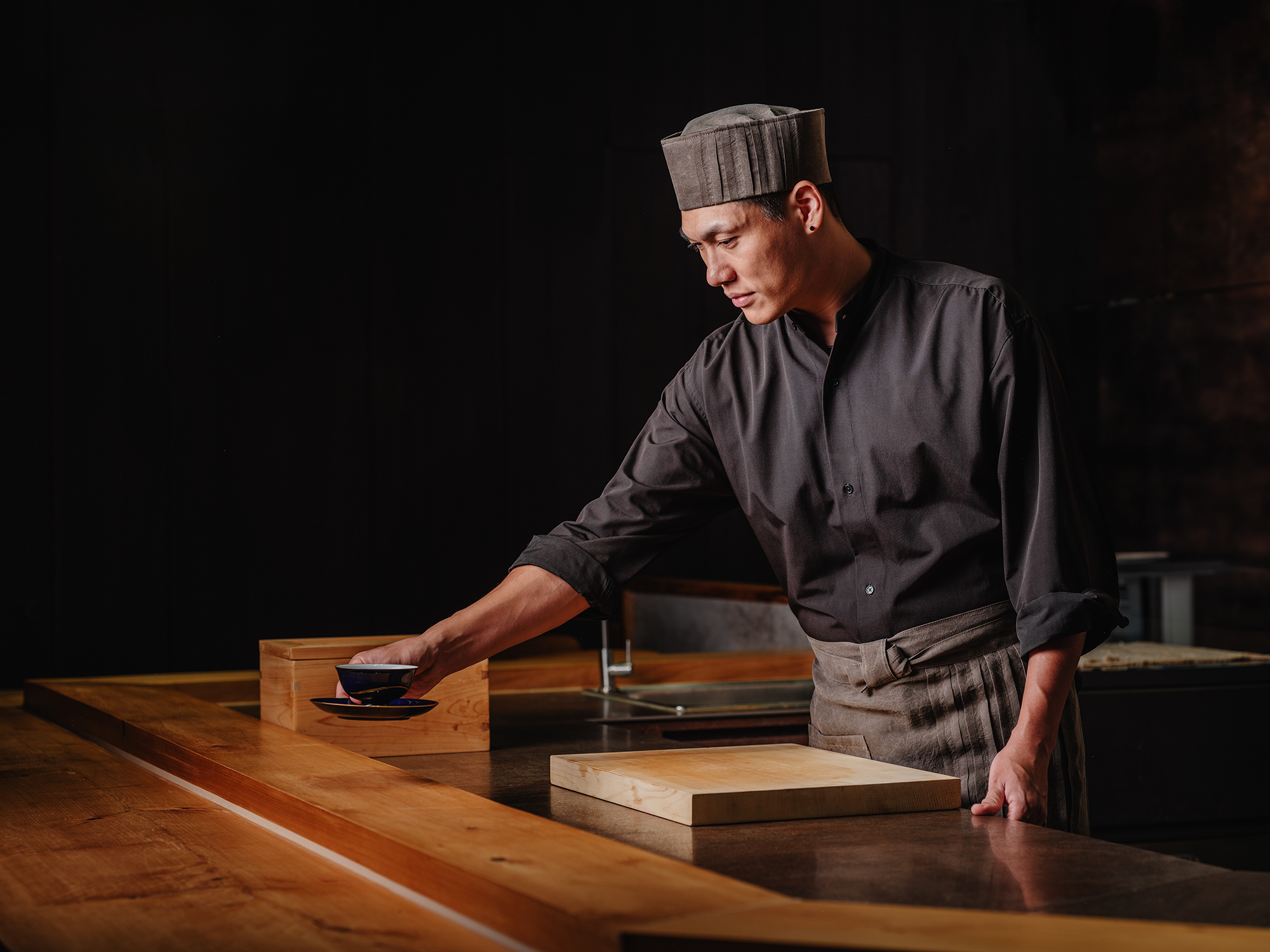
Ren|Sushi Chef
The presence of Shiya (蒔夜) is like the mountains and the sea—no matter who you are, you can find a place to belong here.
Continuing her mother’s spirit of running a Japanese restaurant in Hualien, Ren started experimenting with Japanese-Western fusion cuisine beginning with sushi at a late-night eatery in Hualien. Eventually, at Shiya Sushi, she transforms her curiosity and creativity about cooking into reality. Ren believes that the most important thing is to enjoy eating. During the meal, she explains the ingredients used, cooking methods, and reasons for her choices, sometimes sharing stories of regular customers and recent happenings. It feels less like dining at a restaurant and more like eating at a friend’s house who is an excellent cook—yet through the food, you can clearly sense Ren’s dedication to ingredients. Every bite surprises you with thoughts like, “How did she think of doing it this way?” Ren perfectly blends the finest ingredients from Hualien and various parts of Japan into her dishes, sharing them with many.
【Cuttlefish Ink-Dyed Chef’s Hat and Apron】
Cuttlefish release ink to escape, fleeing to a place where they can find temporary safety—this concept of “safety” is the highest principle Ren wants to convey through her cooking. Ren, who has trained in karate, mentions that the chef’s apron is similar to a karate gi’s belt; wearing it marks a switch in mindset. “Putting it on feels like a ritual; I must enter a state of extreme focus and treat every ingredient that comes into my hands with great care.” The color dyed by cuttlefish ink carries layered shades of gray, resembling clouds, and easily blends into every corner of the restaurant. This mirrors Shiya’s overall atmosphere—an indistinct, hidden sense of shelter. The uneven, random gradients of color resemble the way cuttlefish ink diffuses in water.
楊宗儒|蒔夜壽司主廚
蒔夜的存在就如同山海,無論你是什麼樣的存在,都能在這裡找到棲身之所。
延續媽媽在花蓮開日式料理店的精神,Ren在花蓮從深夜食堂的握壽司開始嘗試和洋合璧料理,一路到蒔夜壽司將對於料理的好奇及創意化為現實。Ren認為吃的開心是最重要的事情,用餐的過程中Ren會一一說明使用的食材、烹飪的方式、選擇的原因,偶爾參雜熟客的日常、近況。比起餐廳,更像在廚藝很厲害的朋友家吃飯,但又能藉由食物感受到Ren對食材的堅持,每吃一口都驚嘆「怎麼能想到要這樣做?」,Ren將花蓮及日本各地好的食材完美結合成料理,傳遞給更多的人。
【墨魚染廚師帽、圍裙】
墨魚吐墨是為了逃跑,逃往一個讓自身得以擁有一個暫時性安心容身之處,如同蒔夜想傳達給客人的理念,以「安心」作為料理最高原則。學過空手道的Ren提到,廚師的圍裙跟道服的腰帶很像,穿上它能感覺到自身模式的切換,「每次在著裝時就像是一個儀式感,必須進入極度專注地狀態,謹慎地對待來到我手上的任何食材。」墨魚汁液染出的顏色帶有多層次的灰,類似雲彩的效果,可以輕易地融入餐廳的任何角落,就像蒔夜這家餐廳的整體氛圍帶著模糊的隱藏庇護感,不均勻的濃淡隨機色彩效果,就像墨魚在水中墨色四散的模樣。


海膽 Sea Urchin
【Habitat and Conditions】 Sea urchins typically inhabit depths of 5 to 20 meters underwater. They prefer colder seawater temperatures between 10°C and 15°C. When the water temperature ranges from 18°C to 20°C, sea urchins tend to lose their appetite; at 25°C, they die. Sea urchins are categorized as either herbivorous or carnivorous, with herbivorous types being the majority.
【Biological Characteristics】 Sea urchins belong to the echinoderm family. Evolutionarily, regular sea urchins appeared earlier, with fossil records dating back to the Ordovician period. Irregular sea urchins only appear in the Jurassic period, making a difference of about 200 million years between the two.
【Collector】Jian Da LU
【Uses】 Mainly consumed as food, the edible parts are the reproductive glands, including the male sperm sacs and female ovaries, also known as “uni” or sea urchin roe. These parts are rich in protein and healthy unsaturated fats. Western medical research suggests they help repair muscles, reduce inflammation, strengthen the immune system, and lower cholesterol.
【Location】 23°48'7.8339" N 121°51’3.1091" E
Cihomoan (Amis language). Located within the Port Tribe of Fengbin Township, this area is a natural bay filled with abundant coral reefs and reef caves. It is common to see local residents bending over the reef rocks observing the caves. Locals jokingly call this place the “children’s pool” because the waves are relatively calm due to the reef barrier. However, this collection site often suffers significant disturbances from outside tourists.
【Collection Process】 Following LU up and down the intertidal zone, “You have to be very careful when catching sea urchins. It’s not about getting pricked by their spines, but sometimes if you don’t quickly hook them out, they get stuck in the cave entrance, making them hard to pull out. And since you want them badly, one wrong move and the wave can knock you into the sea.” Constantly watching all around and listening carefully is the basic survival skill when making a living in nature!
【生長環境與條件】一般出沒在5至20米的水底,海膽喜歡在較冷的海水溫度(10℃-15℃)下生活,若水溫介於18℃至20℃時海膽會食慾不振;若水溫高達 25℃,海膽就會死亡。海膽分為草食性與肉食性兩類,草食性佔多數。
【生物特徵】海膽屬於棘皮動物家族,演化上,正型海膽較早出現,奧陶紀即有化石紀錄。歪型海膽要到侏儸紀才有紀錄,兩者之間相差了2億年。
【採集者】呂建達
【用途】主要以食用為主,可食用的部分為生殖腺,包括雄性精囊和雌性卵巢,又稱為「海膽黃」和「海膽膏」,含有豐富的蛋白質和健康的不飽和脂肪。在西方醫學研究中,可以幫助修復肌肉,抗發炎、強化免疫系統、降低膽固醇。
【位置】23°48'7.8339" N 121°51’3.1091" E
cihomoan,阿美語。位於豐濱鄉港口部落內,地形為一個天然的海灣,有許多大量的珊瑚礁石與礁石岩洞,時常可見在地居民於礁石上彎腰觀察洞穴的情景。在地居民戲稱此地為兒童池,海浪因礁石阻隔相對平穩,也因如此這個採集地時常受到外來遊客干擾甚大。
【採集過程】跟著呂建達在潮間帶裡上上下下,「抓海膽要很小心耶,不是被他刺,而是有時候你沒有迅速地勾出來,牠卡在洞口就很難拉,然後你又很想要,一不小心就被海浪打下去海裡了。」眼觀四面,耳聽八方,是在大自然裡討生活的保命基礎!


HengJones|Hip-hop Artist
Facing the unknown away from home, I hope my music can give the people of my tribe the courage to hold their heads high.
HengJones truly began his professional music career in 2018 with the release of his first EP, Urban Jungle. Later, he gradually gained recognition through the work My Aunt is Also Itchy but also started to avoid and distance himself from his own creations. For HengJones, culture is something very sacred and should not be treated as mere entertainment or pastime. Yet, he believes Indigenous culture should be presented in a cooler way. This contradiction only began to resolve when his music piece Kaying Gets Tough was accepted by the tribe, and he started to recognize that music could be a medium to inherit and innovate culture. HengJones recalls returning to the tribe, where the younger boys treated him like a big star. While feeling embarrassed, he also thought he wasn’t quite qualified yet. Though he says otherwise, this has only strengthened his determination to encourage the younger generation of Indigenous people to embrace their culture through music.
【Sea Urchin Gentleman’s Hat and Accessories】
Because of its spiny exterior and habitat, the sea urchin is often seen as a somewhat dangerous and unapproachable creature. However, once its spines are removed, its surface forms numerous holes that resemble little steamed buns with delicate, flower-like bite patterns—an adorable contrast between inside and outside. This duality closely mirrors Daheng’s personality.
On stage, HengJones is a powerful and charismatic rapper, expressing his thoughts about the tribe and his surroundings through lyrics. Offstage, however, he is often teased as a shy big boy. The sea urchin’s spines on the gentleman’s hat are arranged randomly like organic star dots, while the brooch displays parallel rows that highlight texture and color. When worn by Daheng, it’s like his hip-hop songs: seemingly irreverent but filled with gentle and deep emotion.
大亨 HengJones|嘻哈音樂人
在外地面對未知,希望我的音樂能讓部落的人擁有抬頭挺胸的勇氣。
大亨真正將音樂作為職業是從2018年發行了第一張EP〈都市叢林〉開始。隨後以作品《我阿姨也癢》開始逐漸被看見,卻也開始逃避及脫離自身的創作。對於大亨而言,文化是非常神聖的東西,不該被作為娛樂及消遣,但他又認為原住民文化應該能夠以更酷的方式呈現,這樣的矛盾直到音樂作品《Kaying改硬》被部落接受後,才開始認可自己能夠將音樂作為傳承與創新文化的媒介。大亨提起自己回到部落,總是被部落的弟弟們捧成大明星,覺得不好意思的同時也認為自己還不夠資格。嘴上說著沒有啦,但卻讓大亨更加堅定的選擇透過音樂鼓勵原住民族年輕一代認識自己的文化。
【海膽紳士帽、帽飾】
海膽因其帶刺的外表及生長環境,往往被視為帶有一點危險性及不易親近的生物,但把海膽的刺去掉之後,表面會形成一個一個的孔洞,形狀有點像饅頭並帶有類似咬花紋理的可愛模樣,而這內外反差的形象,與大亨非常相似。
大亨在表演時是一位氣勢極強的饒舌歌手,藉由歌詞表達自己對於部落以及身邊人事物的想法。但事實上,大亨在舞台之外常常被人調侃是個害羞的大男孩。海膽尖刺在紳士帽上長短隨機排列的有機星點,再到胸針平行陣列凸顯質感及色彩,穿戴在大亨身上,就如同他的嘻哈歌曲,看似玩世不恭,但卻蘊含著溫柔且濃郁情感的內在。


土雞 Native Chicken
【Habitat and Conditions】 Chickens require a well-ventilated and dry environment for healthy growth; excessive moisture can cause skin diseases. Woodland, farmland, and hillside environments each pose unique challenges, making the effective decomposition and cleanliness of waste crucial.
【Biological Characteristics】 These chickens feature a pea-shaped comb, with feathers mixed in reddish-brown and golden yellow. They have a straight and upright posture, small round wattles, large prominent round eyes, a long slightly curved beak, a long neck and short back, a broad and deep chest, and yellow-colored shanks.
【Collectors】Zi Jun WANG, Xiang Lan MA
【Uses】 Today, chickens are primarily raised for consumption, but different communities also have special uses for them. Whole chickens may be used for nourishment, rituals, or feather crafting, with every part serving a purpose. National Chung Hsing University in Taichung has established the “Local Chicken Genetic Resource Center” to preserve the genes of disappearing native chicken breeds and build a seed conservation database.
【Location】 23°57'7.3210" N 121°32’6.7723" E
Mayuan Tribe, located at the foot of the Central Mountain Range in Wanrong Township, is the only Dan community of the Bunun people in Hualien. The Dan tribe members relocated here from Nantou’s Danda area during the Japanese group relocation policy between 1933 and 1937. Since 2009, the youth of Mayuan Tribe have initiated a series of actions to reconnect with their roots and practice ancient wisdom in contemporary ways, deeply reconsidering the meaning of “Ming Bunun.”
【Collection Process】 Following barefoot footprints and a strong back into an orange orchard, healthy red-feathered native chickens run freely in the orchard. “For us Dan Bunun men, hunting is a basic skill. Before going up the mountain with the elders, catching and handling chickens in open spaces is practice. More importantly, it starts with learning to respect all forms of life,” says the young Wang Zijun, just in his early twenties.
【生長環境與條件】雞隻成長環境需要通風乾爽,過度潮濕會讓皮膚產生病變。林地、農地、山坡地需要克服的環境條件不盡相同,排泄物的有效分解與清潔至關重要。
【生物特徵】特徵為豆冠型雞冠,羽毛為紅褐色與金黃色交雜分佈,具有直立挺拔的體型,肉髯小而圓,眼大圓而突出,喙長而略彎曲,頸長背短,胸平寬深長,腳脛呈黃色。
【採集者】王子駿、馬香蘭
【用途】現今雞隻主要以食用為主,在不同的族群中有不同的特殊使用方式。無論是滋補、祭祀、羽毛飾品製作等,全雞皆有其用途。台中中興大學成立「地方雞種遺傳資源中心」,替逐漸消失的多元本土雞種盡可能保留其基因並建立種原保種資料庫。
【位置】23°57'7.3210" N 121°32’6.7723" E
馬遠部落,座落於萬榮鄉中央山脈山腳下,是花蓮僅有的丹社群布農族人聚落。馬遠的丹大社人是在1933年至1937年間在日本人集團移住政策下遷移到花蓮萬榮鄉,從2009年開始,馬遠部落青年發起一系列尋根與古老智慧當代實踐的行動,重新思考「Ming Bunun」的深刻意義。
【採集過程】跟著赤腳踩出的腳印及壯碩的背影走進橘子園中,看到健康體魄的紅羽土雞在果園中自由奔跑。「我們丹社群布農族的男人要會打獵是基本技能。在跟著長輩上山前,能在開放空間抓雞和處理算是練習,更重要的是從學會尊重任何生命開始。」現年不過二十初頭的王子駿說。


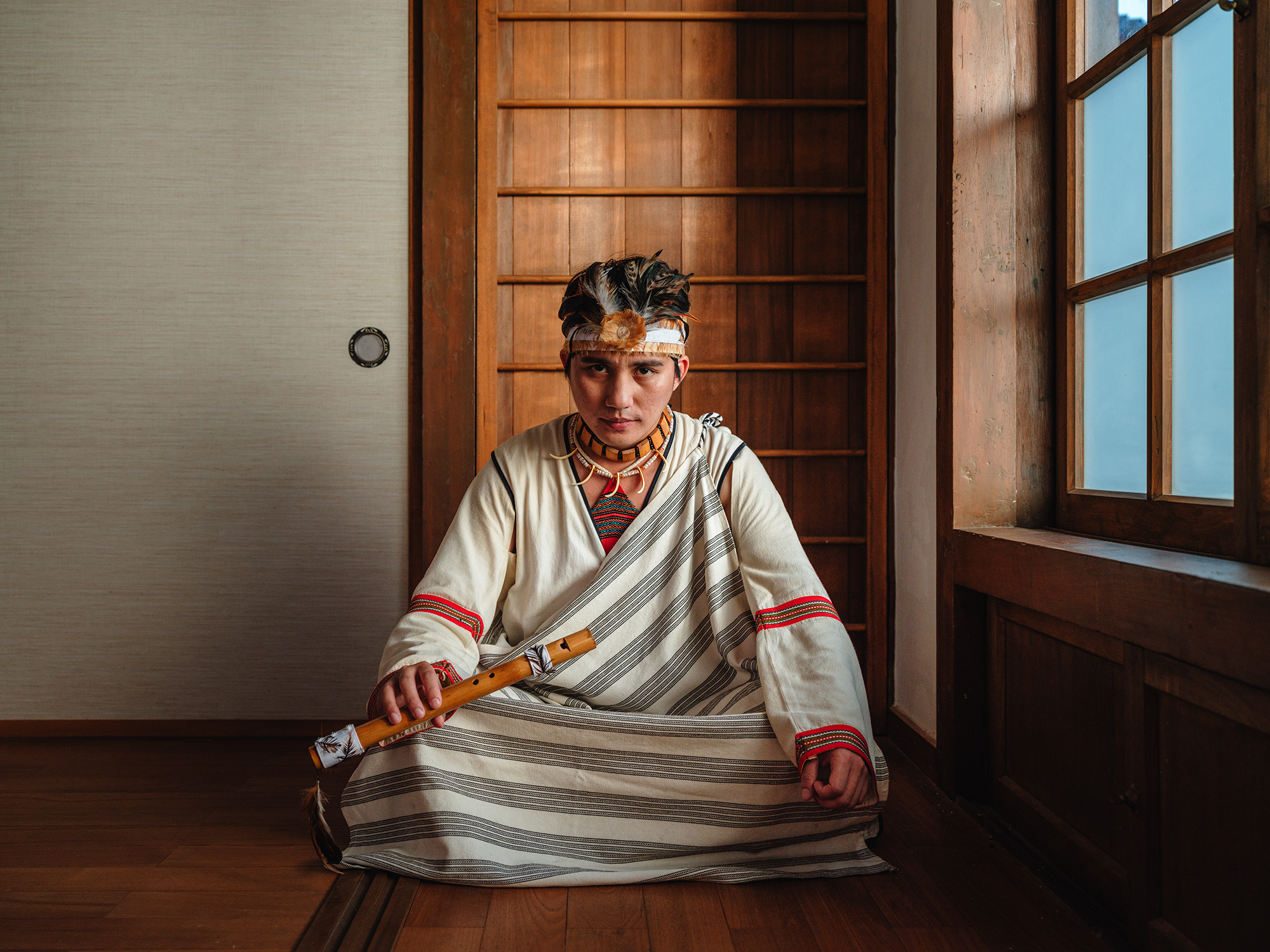
Labaga Taru|Traditional Hunting Flute Musician
Many people ask me if I want to be like the elders—serene and reserved. But their way of being comes from a particular time and context. What truly matters is whether we practice the values we believe in. I am already on that path, using music to inscribe culture deep within my heart.
“In Hualien, we have our own traditional instruments. I hope these instruments can enter schools just like the recorder, becoming more widely known and played.” Due to historical disruptions, the Truku culture was fragmented for nearly 120 years. Only recently have we begun to piece together and reclaim our cultural roots. The hunting flute, known as Pgagu, is one such instrument. Labaga Taru is a contemporary educator and performer of the hunting flute, promoting it through performances around Taiwan and workshops back in the tribe. He has also compiled teaching materials, helping the promotion and inheritance of hunting flute culture gradually become a mature system.
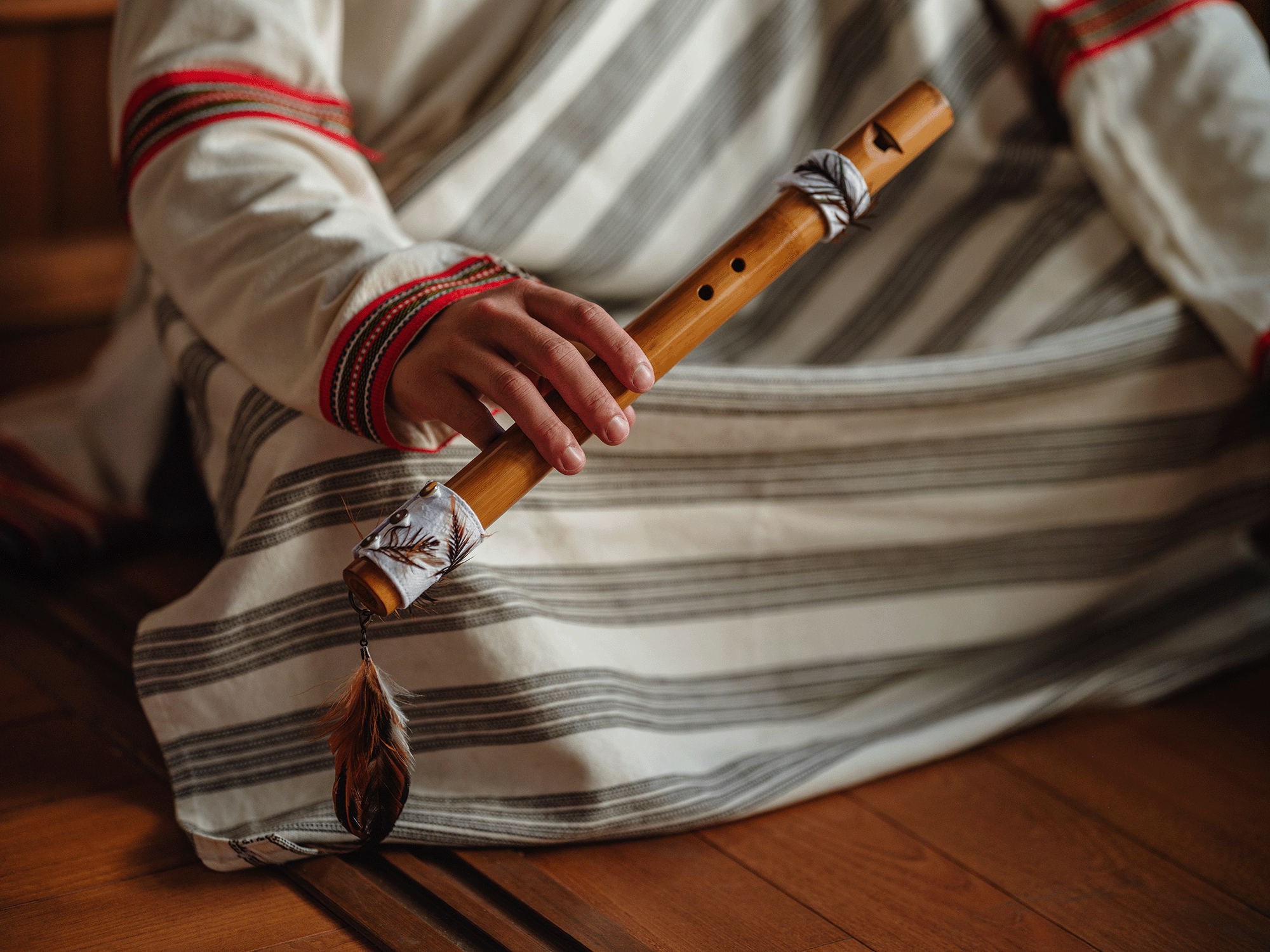
【Chicken Feather Headband & Hunting Flute Ornament】
Traditionally, animals play an important role in tribal rituals. Even now, though living in Taipei, when Labaga Taru moves houses, his father still follows tradition by bringing a chicken to bless the new home. “In our family, chickens are the most commonly used animals for blessings—whether moving, buying a new car, weddings, funerals, or important announcements. So I feel a very strong connection to them.” Using the traditional technique of paper casting, chicken feathers are sealed into paper that gradually emerges into a three-dimensional form, capturing the dynamic motion of feathers in flight. Wearing a chicken feather adornment symbolizes profound identity and connection. The traditional indigenous meanings and uses of animals are translated into this object, representing a condensed and visualized experience of Haocheng’s personal growth.
謝皓成 Labaga Taru|獵首笛演奏家
很多人問我有沒有想要像老人家一樣文面?文面有當時的時空背景,主要的是心中認同的價值自己有沒有去實踐,我現在已經在實踐的路上,用音樂的方式讓文化紋在心上。
「花蓮這塊土地上就有自己的傳統樂器,希望這些樂器也能夠像直笛一樣進入到學校裡,更普遍地被認識及吹奏。」太魯閣族文化因歷史因素斷層了將近120年,在近代才開始慢慢拼湊及找回自己的文化根源。而獵首笛就是其中一項。獵首笛(Pgagu)為太魯閣族傳統樂器之一,謝皓成作為當代獵首笛的教育推廣者及演奏家,透過各地的展演和回到部落辦理工作坊的方式,能讓獵首笛被更多族人甚至大眾認識。謝皓成也同時編寫教本,讓獵首笛文化的推廣和傳承,逐漸成為一套成熟的系統。
【雞羽毛頭帶、獵首笛綴飾】
傳統上部落裡會透過動物進行祭祀,即使現在生活在台北,謝皓成在搬家時,爸爸依舊會遵循傳統,帶著雞到新家中進行祝福儀式。「我們家最常使用的就是雞這個動物來祝福身邊的人,無論是搬新家、買新車、還是婚喪喜慶,或有訊息要告知時都會使用。所以我個人對其有滿強烈的連結。」應用抄紙工藝將雞羽毛封存在紙張之中,設計上讓它逐漸從紙張中跳脫出來成為立體,賦予雞躍動時羽毛呈現的動態感。佩帶雞羽毛物件於身上時,意味著深遠的身份認同與連結。傳統原住民對於動物的運用及意涵,被轉譯體現在物件上,也代表著謝皓成的成長經驗濃縮及展示。


2024
Hualien Animals Color
10 animal materials x 100 texture experiments
into 10 contemporary jewelries & wearable artwork
for 10 Hualien figures
Artist Dondon Hounwn
Fish bone|contemporary jewelries
DJ Dungi Sapor
Lac insect|outwear
Traditional flute musician Labaga Taru
Chicken feather|headband and flute decoration
Cafe host Jeannie
Cow dung|contemporary jewelries
Sushi chef Ren
Squid ink|chef hat and apron
Hip-hop artist Heng Jones
Urchin thrones|hats and pins
Traditional harp musician Ibu Tanapima
Pig blood|contemporary jewelries
Tradiitonal archer Rung-Huei TSENG
Scarab beatle|traditional bow
Siva 9 Band
Lobster tail|contemporary jewelries
Gyrotonic athlete Anne
Corded turban|contemporary jewelries
2024 | Hualien Color #003 | 10/01-10/31 | Hualien Prefecture Forestry Office | Hualien
adviser|Hualien County Government
organizer|Culture Affairs Beauru, Hualien County Government
operator|Hualien Design Center
curator|Sen Shen Studio, Studio Kao Gong Ji
art director|Cheng Tsung FENG
fashion designer|Chia Chuan LI
textile craftsman|Si Ray CHEN
project manager|Ko Fan LIN
journal photographer|FIXER Photographic Studio
journal copywrite|Sheng Da TSAI, Kuan Yin LI
production|Chia Chuan LI, Chan Wei HSU, Chen PENG, Chong Sheng HSU, Jia CHEN
exhibit designer|Chan Wei HSU, Kuan Wei WU, Chen PENG
lighting design|Oude Light
graphic design|Tzu Chi YIN
PR promotion|Hsuan Ju YU
woodwork|Feng Yi CHIU
lighting engineer|Beamtec Lighting
pinting | 6Jian Into
event food design | Aredetay
event PE|Aido Audio Tech
venue|Hualien Department, Forestry and Nature Conservation Agency, MOA
2024
花蓮人拾花蓮材 # 003 取色於生物的創造計畫
在花蓮採集10種生物材質x實驗超過100種色彩質地效果
為10個花蓮人物x創作10組穿戴式作品
藝術家 東冬‧侯溫 Dondon Hounwn
魚骨|當代首飾
DJ 汝妮 Dungi Sapor
紫膠蟲|服裝
獵首笛演奏家 謝皓成 Labaga Taru
雞毛|頭帶與笛飾
北非咖啡老闆 林心瑀 Jeannie
牛糞|當代首飾
蒔夜壽司主廚 楊宗儒 Ren
墨魚汁|廚師帽與圍裙
嘻哈音樂人 大亨 Heng Jones
海膽棘刺|紳士帽與胸針
弓琴技藝傳承者 江寶惜Ibu Tanapima
豬血|當代首飾
傳統弓箭手 曾榮輝 Rung-Huei TSENG
金龜子鞘翅|傳統竹弓
台玖線樂團 Siva 9 Band
龍蝦尾鰭|當代首飾
嬋柔老師 林桂安 Anne
台灣蠑螺口蓋|當代首飾
2024 | 花蓮人拾花蓮材 # 003 取色於生物的創造計畫 | 10/01-10/31 | 花蓮港山林事業所 | 花蓮
指導單位|花蓮縣政府
主辦單位|花蓮縣文化局
承辦單位|花蓮設計中心
策展單位|森深試務所、考工記工作室
藝術總監|范承宗
服裝設計|李嘉泉
染織工藝|陳思睿
專案經理|林可凡
採訪攝影|定影影像
採訪文字|蔡昇達、李冠穎
物件設計與製作|李嘉泉、許展維、彭程、徐崇盛、陳小加
展示設計|許展維、吳冠葳、彭程
照明設計|偶得設計
平面設計|銀子奇
媒體行銷|游琁如
展場施作|邱逢宜
照明工程|丞逸照明
影像輸出|六角廣告
活動食物設計|阿樂樂代
活動設備|艾杜音響
場地協力|林業及自然保育署花蓮分署